Rasputin’s Death Chart: Timing Back from the Moment of Death
Update: a follow-up study rectifies Rasputin’s birth time from the events of his life and this death chart, and proposes sidereal Leo rising, at about 7:31 or 7:52 pm. Read Rasputin’s Birth Time: Rectifying the Ascendant from His Life and Death.
According to Richard Fidler, the chart for the moment of death is in many respects like a birth chart: it can be read as a description of the deceased person’s character and destiny. All of this is admittedly speculative, but it seems at least theoretically plausible that timing techniques could also be applied to death charts. For this purpose Sidereus Academy has designed a converse secondary progressions tool which, unlike converse progressions from the birth chart, works back from the date of death at the rate of one day for one year. In this study we try to fine-tune the time of Rasputin’s death, taking the historical accounts of his murder as the starting point.
The accounts of the murder at the Yusupov Palace allow a death time between about 2:45 and 4:00 am on 30 December 1916. Converse progressions from a death chart cast for 3:00 am time the main turning points of Rasputin’s life with tight contacts to the angles, and those contacts narrow the window to roughly 2:57–3:07 am. Small changes to the death time quickly break them.
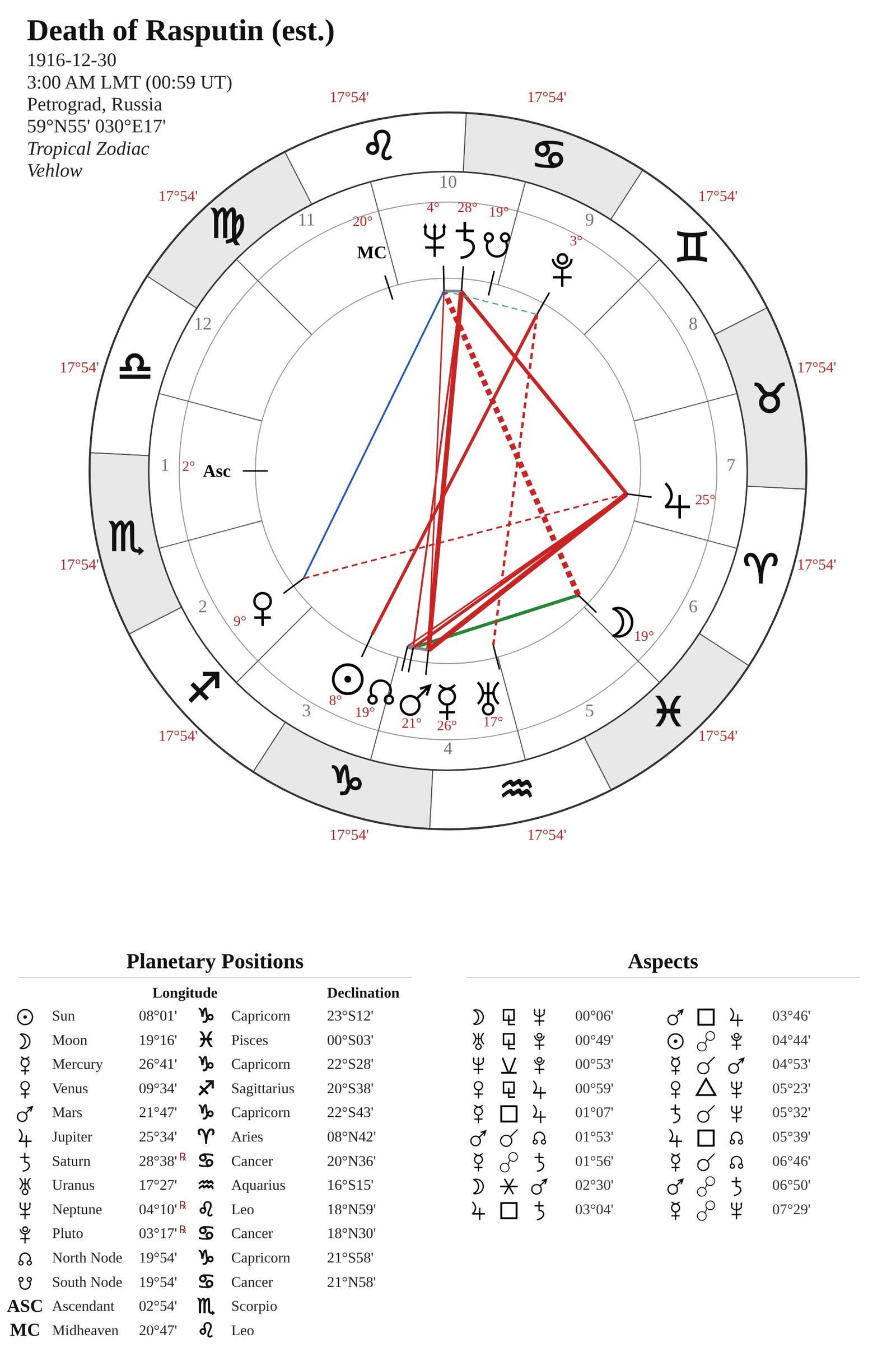
The chart for 3:00 am
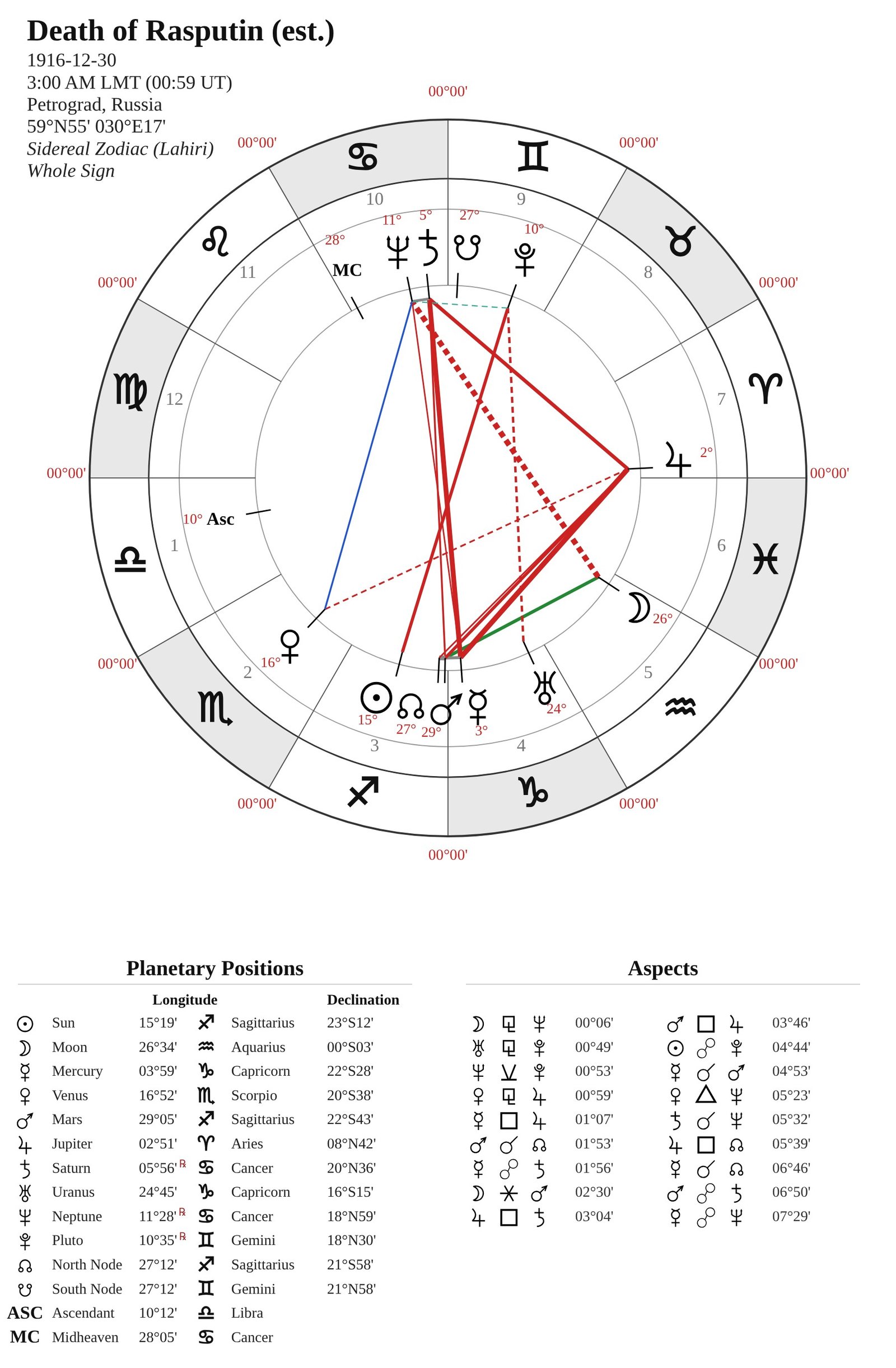
The speculative time of death produces a chart that fits Rasputin remarkably well.
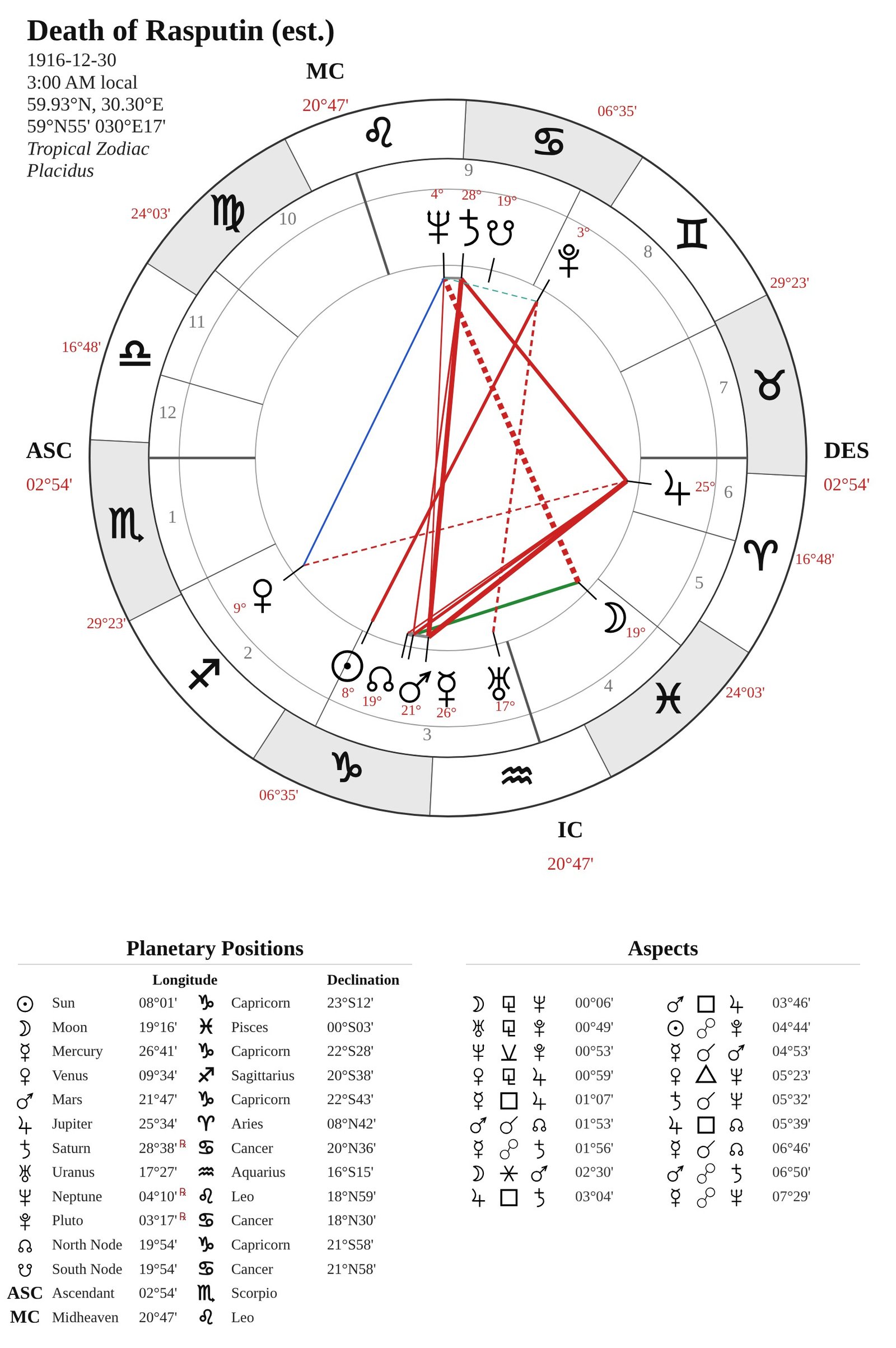
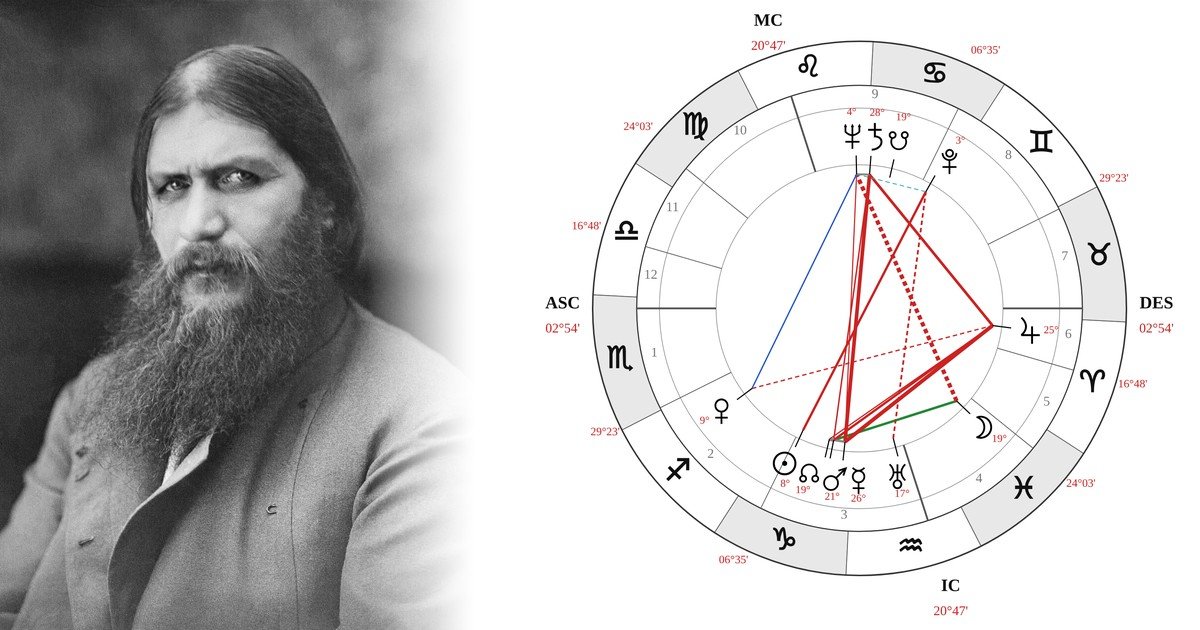
Saturn and Neptune in the 10th. In the Vehlow chart, which puts the Ascendant in the middle of the 1st house, the 10th house runs from 17°54′ Cancer to 17°54′ Leo and holds Saturn (28°38′ Cancer), Neptune (4°10′ Leo) and the South Node (19°54′ Cancer). In the sidereal whole-sign chart, Saturn and Neptune fall together in Cancer, again in the 10th. Saturn in the 10th often raises people to great heights of power and influence, but it is also associated with dramatic reversals: a Siberian peasant raised into the inner circle of the imperial court, then killed by members of the aristocracy. Saturn combined with Neptune can be taken as the signature of a monk or renunciate, and the South Node supports the theme. With these planets in the angular 10th, they show his vocation and public identity: the holy man.
Neptune square the Ascendant. Neptune is square the Ascendant within 1°16′. This supports a reputation shrouded in mystery and intrigue, and the rumours of drunkenness and debauchery that surrounded him. Neptune is also poison and water, and the legend of his murder, with cyanide in the cakes and wine and his body pulled from the frozen Malaya Nevka, is thoroughly Neptunian (the autopsy findings are disputed). Neptune’s influence is amplified by the Moon’s sesquiquadrate to it, within 6′.
A strong dose of Scorpio. In the sidereal chart Libra rises, and its lord, Venus, occupies Scorpio. This brings the intensity, the aura of sexuality and scandal, the devoted female following and the reputation for being almost impossible to kill. For those who prefer the tropical zodiac, Scorpio rises outright, so whichever zodiac one uses, the Scorpio note is strong.
The Sun. The Sun in sidereal Sagittarius describes a traveller, seeker and religious figure. Rasputin was a strannik, a wandering pilgrim who walked to Mount Athos and Jerusalem. Although wide (4°44′), the Sun’s opposition to Pluto indicates a powerful, charismatic person who would be prone to becoming embroiled in power struggles with powerful people.
The data
All dates are Gregorian, with the Old Style date in brackets. Petrograd kept local mean time, UT + 2h 01m. Rasputin’s birth date is documented but not his birth time, so the birth chart plays no part here.
| Event | Date and time | Place | Basis |
|---|---|---|---|
| Death (estimated) | 30 Dec 1916 (17 Dec OS), 3:00 am LMT = 00:59 UT; window 2:45–4:00 am | Yusupov (Moika) Palace, Petrograd, 59°55′47″N 30°17′58″E | Yusupov was “getting worried” at about 2:30 before the first shot; the fatal courtyard shot followed |
| First meeting with Nicholas and Alexandra | 14 Nov 1905 (1 Nov OS), tea about 4:15–5:00 pm | Sergievka, Peterhof | Nicholas II’s diary |
| Meets the children | 26 Oct 1906 (13 Oct OS), 6:30–7:30 pm | Peterhof | Nicholas II’s diary |
| Spała telegram | about 13 Oct 1912 | Sent from Pokrovskoye | Sources differ by days |
| Stabbed by Khioniya Guseva | 12 Jul 1914 (29 Jun OS), about 3 pm | Pokrovskoye | Biographies |
The method
- One day before death = one year before death. The progressed chart is cast for a moment as many days before the death as the event is years before it, so the ephemeris and the life are both read backwards together.
- The other convention. One day after death could equally stand for one year before death. This mirrors conventional converse progressions from the birth chart, where a day before birth stands for a year after it. It is not tested here, and it is a natural next study.
- Angles move by the solar arc in longitude (the Sidereus Death Chart Timing Explorer). Orb 1°.
- What can fix the minute. Contacts to and from the progressed angles, and to a lesser extent the progressed Moon, change quickly with the death time. Contacts between progressed and death-chart planets form on the same dates whether he died at 2:45 or at 4:00. They can support the method, but they cannot fix the time, so they are kept apart in the section below headed “Contacts that support the method”.
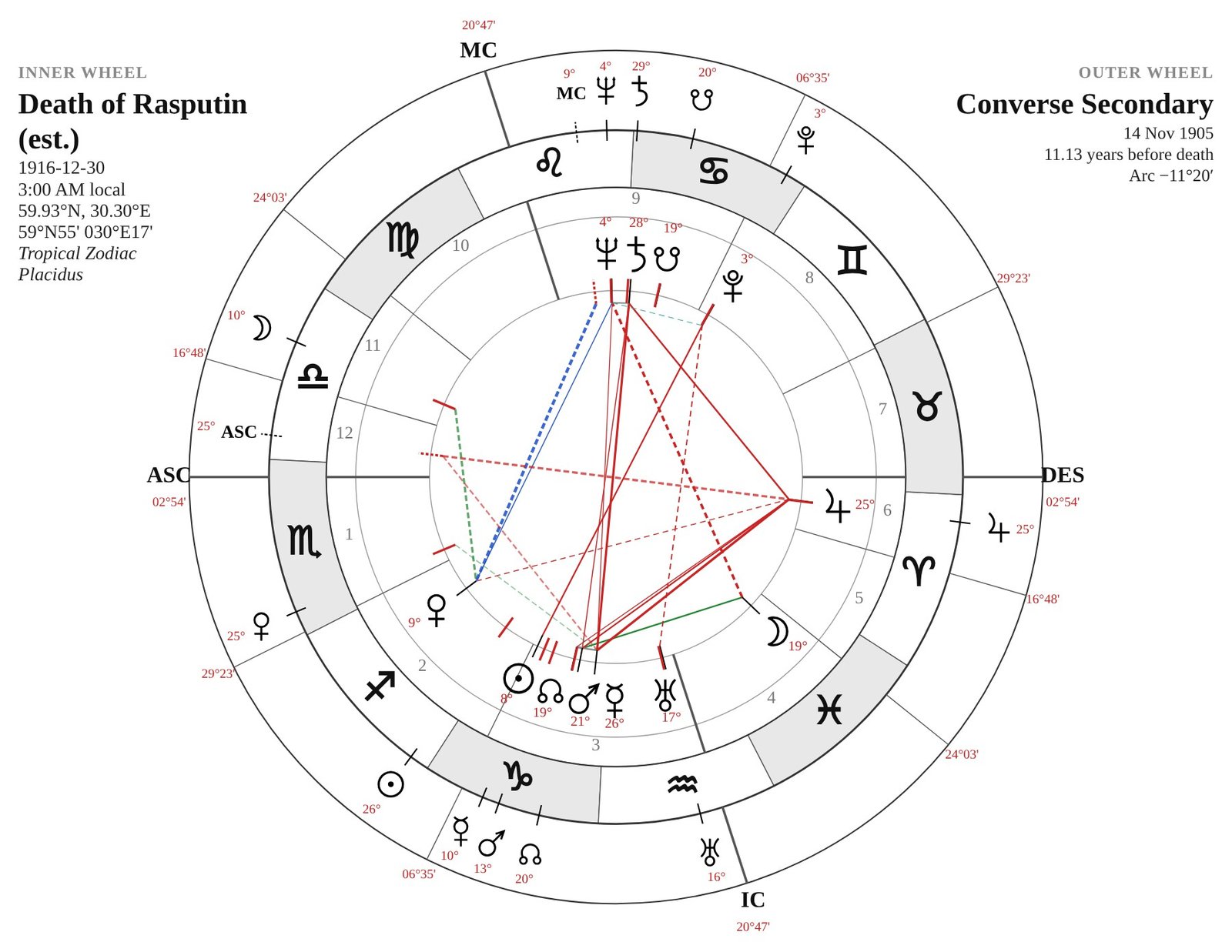
1. The angles at the first meeting with the royals
On 14 November 1905, 11.13 years before death (arc −11°20′), the progressed MC trines Venus and the progressed Ascendant opposes Jupiter.
| Progressed | Aspect | Death chart | Orb |
|---|---|---|---|
| MC 9°27′ Leo | trine | Venus 9°34′ Sagittarius | 7′ |
| Ascendant 25°59′ Libra | opposite | Jupiter 25°34′ Aries | 25′ |
| Ascendant | square | Mercury 26°41′ Capricorn | 43′ |
Solving for the death time
The progressed Ascendant moves about 0.16° for each minute of death time. Making its opposition to Jupiter exact on each candidate date gives:
| Opposition exact on | Implied death time |
|---|---|
| 1 Jul 1903 (Kazan period) | 3:06:49 am |
| 1 Jan 1904 | 3:04:50 am |
| 1 Jul 1904 (arrival in St Petersburg) | 3:02:51 am |
| 1 Oct 1904 | 3:01:51 am |
| 1 Jan 1905 | 3:00:51 am |
| 14 Nov 1905 (meets the royals) | 2:57:24 am |
Whichever event the contact marks, the death time falls between about 2:57 and 3:07 am.
2. The angles at later events
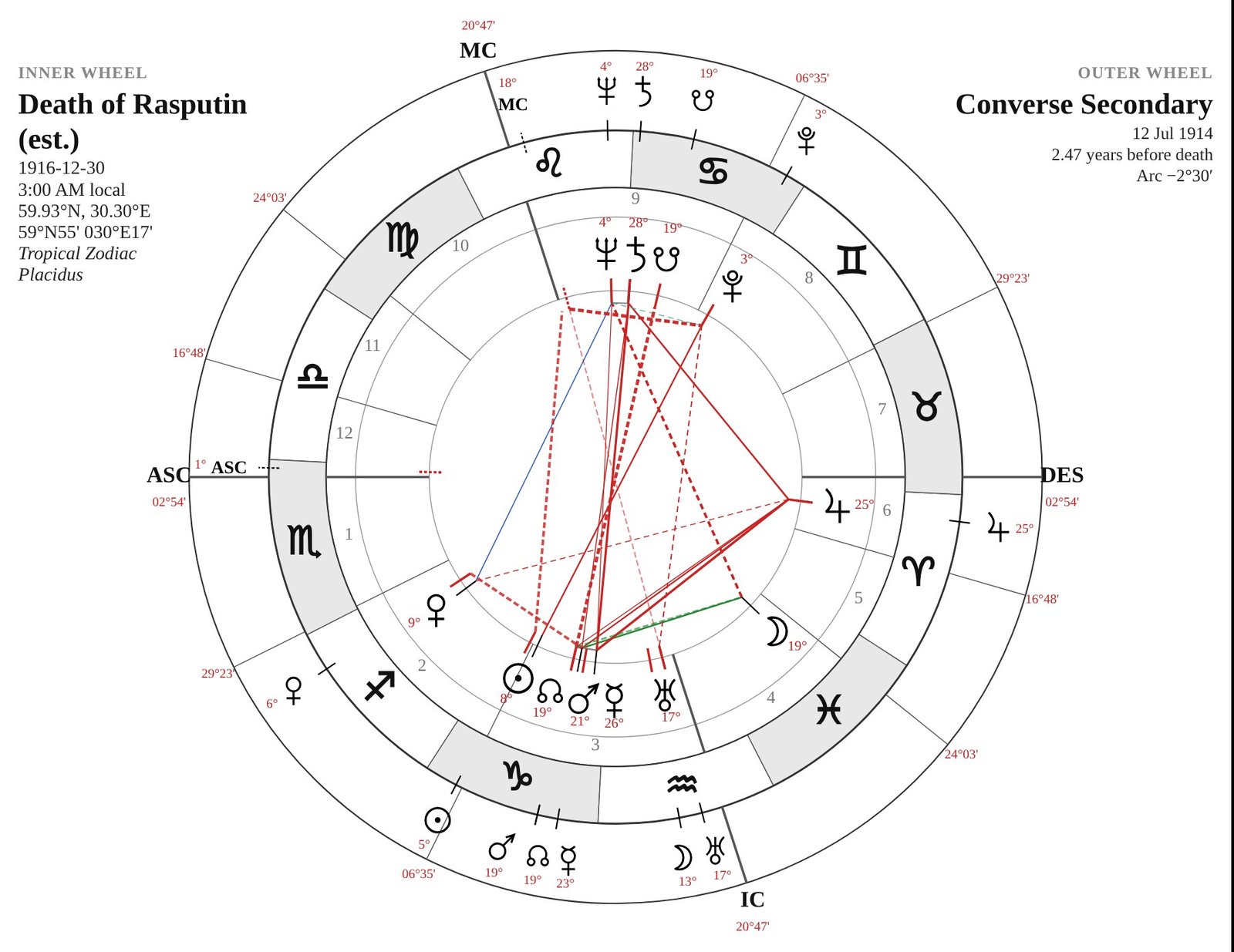
The same 3:00 am chart, unchanged, gives an apt angle contact at the later dated events.
| Event | Years before death | Angle contact (progressed to death chart) |
|---|---|---|
| Stabbed by Guseva, 12 Jul 1914 | 2.47 | MC semi-square Pluto, exact (0′); MC opposite Uranus (49′) |
| Meets the children, 26 Oct 1906 | 10.18 | Ascendant square Mercury (7′); MC trine Venus (51′) |
| Spała telegram, ~13 Oct 1912 | 4.21 | Sun sextile Ascendant (49′); MC opposite Uranus (58′), both wide |
3. The progressed Moon by declination
At the meeting with the royals the progressed Moon, at 8°43′S, is contra-parallel Jupiter at 8°42′N, within 1′. The Moon was crossing the equator, changing declination by about 5° a progressed day, which is roughly 0.2′ for each minute of death time. A 1′ orb therefore holds for only about five minutes either side of the time used. The contact does not depend on the angles, so it is a second, independent check on a death time close to 3:00 am.
4. The eclipses
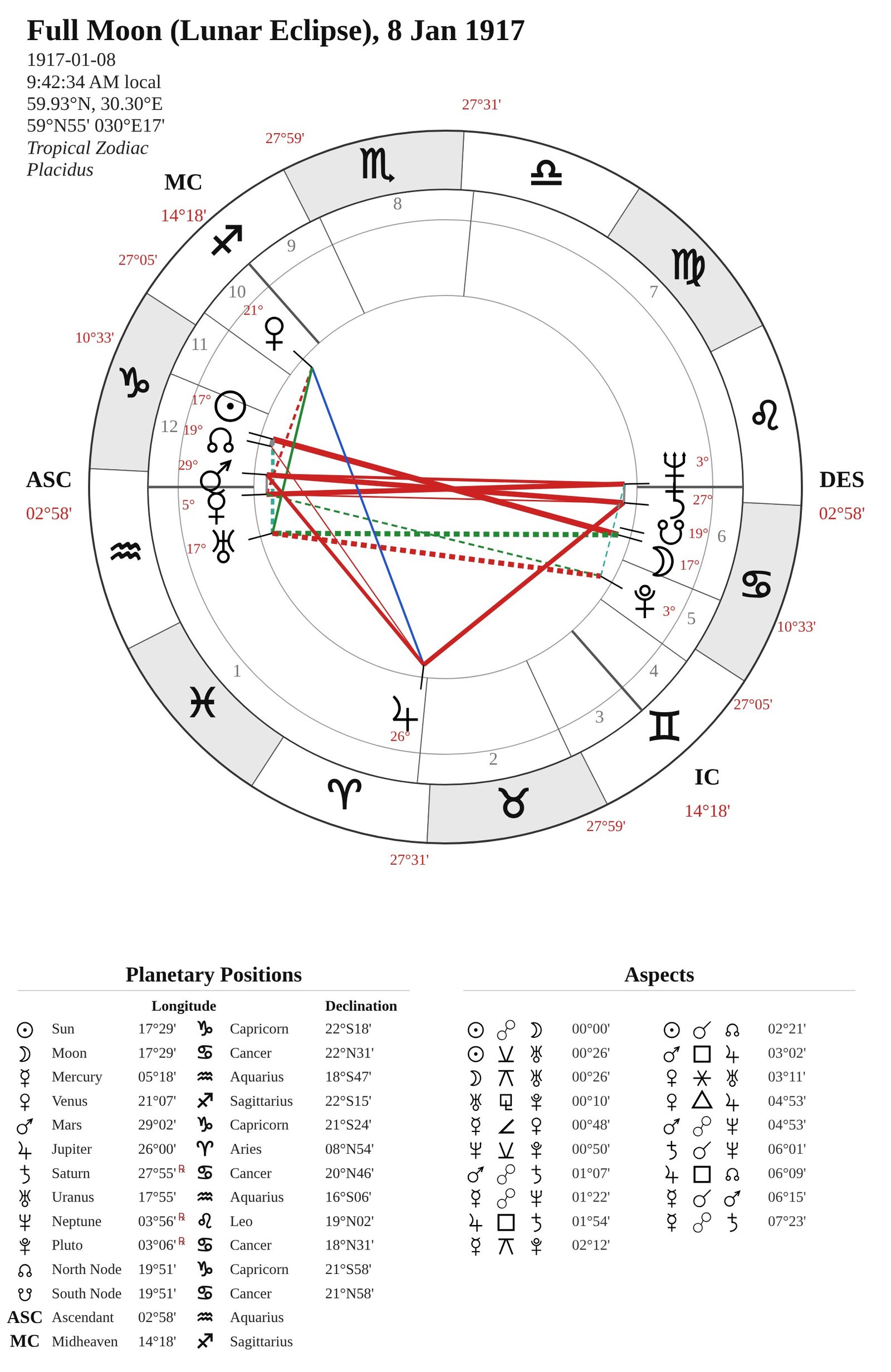
Rasputin died five days after a partial solar eclipse (24 Dec 1916) and nine days before a total lunar eclipse (8 Jan 1917). Both charts are cast for the exact lunation at the Yusupov Palace.
| Eclipse | Exact lunation | Key contacts with the death chart |
|---|---|---|
| Partial solar, 24 Dec 1916 | 10:31:50 pm LMT, 2°44′ Capricorn | Opposite death Pluto 3°17′ Cancer (33′); falls on the 3rd-house Capricorn group |
| Total lunar, 8 Jan 1917 | 9:42:34 am LMT, 17°29′ Capricorn/Cancer | Eclipse Ascendant 2°58′ Aquarius square death Ascendant 2°54′ Scorpio (4′); axis 2–4° from the death chart’s nodes and Mars |
The lunar eclipse Ascendant squaring the death Ascendant within 4′ is the most time-sensitive link in the study, and it holds only if death came close to 3:00 am.
The same eclipse also stands out by declination for the place itself. The eclipsed Moon at 22°31′N is exactly contra-parallel the Petrograd MC at 22°31′S, with the Sun parallel the MC within 13′. This does not bear on the death time, but it suggests the eclipse was especially likely to manifest at that location in some way.
The eclipse chart’s horizon carries a picture of the murder itself. Mercury (5°19′ Aquarius) and Mars (29°03′ Capricorn) rise together, opposite Saturn (27°55′ Cancer) and Neptune (3°56′ Leo) setting. Mercury–Mars opposite Saturn–Neptune aptly describes the killing of a monk in a duplicitous plot. The eclipse Ascendant at 2°58′ Aquarius sits 47′ from the Mercury/Mars midpoint (2°11′ Aquarius) and 1°25′ from the midpoint of all four planets (1°33′ Aquarius), so at Petrograd the whole configuration was on the horizon.
5. Contacts that support the method (not time-sensitive)
These contacts form on the same dates whatever the minute of death, so they say nothing about 2:57 versus 3:07. They are included because they show converse progressions from the death chart producing apt timing for known events.
- Rise through the clergy (1904). The progressed Sun trines Jupiter, exact around 8 Oct 1904 to the death-chart Jupiter and 24 Aug 1904 to the progressed Jupiter. This matches his arrival in St Petersburg in mid-1904 and his taking-up by Theophan and the Alexander Nevsky Lavra, which led to court.
- The Spała telegram (Oct 1912). Progressed Venus trines Neptune within 10′ at the “healing” telegram.
- Away from court. Only the seasons are known, so these confirm periods rather than dates:
| Exact | Contact | Context |
|---|---|---|
| 4 May 1911 | Progressed Moon trine Jupiter | During the Jerusalem pilgrimage |
| 18 Jul 1911 | Progressed Sun semi-square Uranus | Back from the pilgrimage |
| 4 Mar 1912 | Progressed Moon conjunct Sun (3rd house) | Start of the 1912 exile |
| 29 Dec 1912 | Progressed Moon conjunct North Node | Return to the capital |
Not every contact fits so neatly. The progressed Sun sextile the Ascendant, exact on 25 Dec 1911, coincides with the start of Iliodor’s denunciations, but its symbolism is not especially apt there. It may have had a different significance that the record does not show.
Scope of this study
This is a pilot study. It offers anecdotal evidence for one timing method and a hypothetical refinement of the death time, not a proof. A few notes on how to read it:
- Retrospective by nature. Any work with a death chart looks back over a life already lived. What matters is whether the tightest contacts at each event are also the apt ones. Here they mostly are, and the closest are to the angles.
- The angles. They are moved by the solar arc in longitude, a widely used convention for progressed angles.
- Orbs for slow contacts. The converse Sun moves about 1° a year, so a 1° orb on a planet-to-planet contact spans roughly two years. These contacts date periods; the angles and the Moon date moments.
- Further work. The “one day after death” convention, and other timing techniques applied to death charts, are open for future studies. In an earlier trial with Queen Elizabeth II’s death chart, her wedding fell within 2′ of a converse progressed Sun–Venus sextile, the aspect exact eleven days later.
On this evidence the most likely death time is about 2:57–3:07 am, and converse secondary progressions from the death chart produce apt timing for the turning points of Rasputin’s life.
Sources
- The murder of Rasputin, The National Archives blog
- Grigori Rasputin, Khioniya Guseva and Pokrovskoye, Wikipedia
- Глава 5. Обретение Друга (Nicholas II’s diary entries), proza.ru
- Rasputin, the Romanovs, the Imperial Duma and the government, Taco Tichelaar
- Spiridovich, Rasputin, Projekt Gutenberg
- “The little one will not die”, History of Royal Women
- Queen Elizabeth II’s time of death: death certificate, as reported by Al Jazeera
- Positions computed with the Swiss Ephemeris; charts drawn with the Sidereus Astrology Suite.