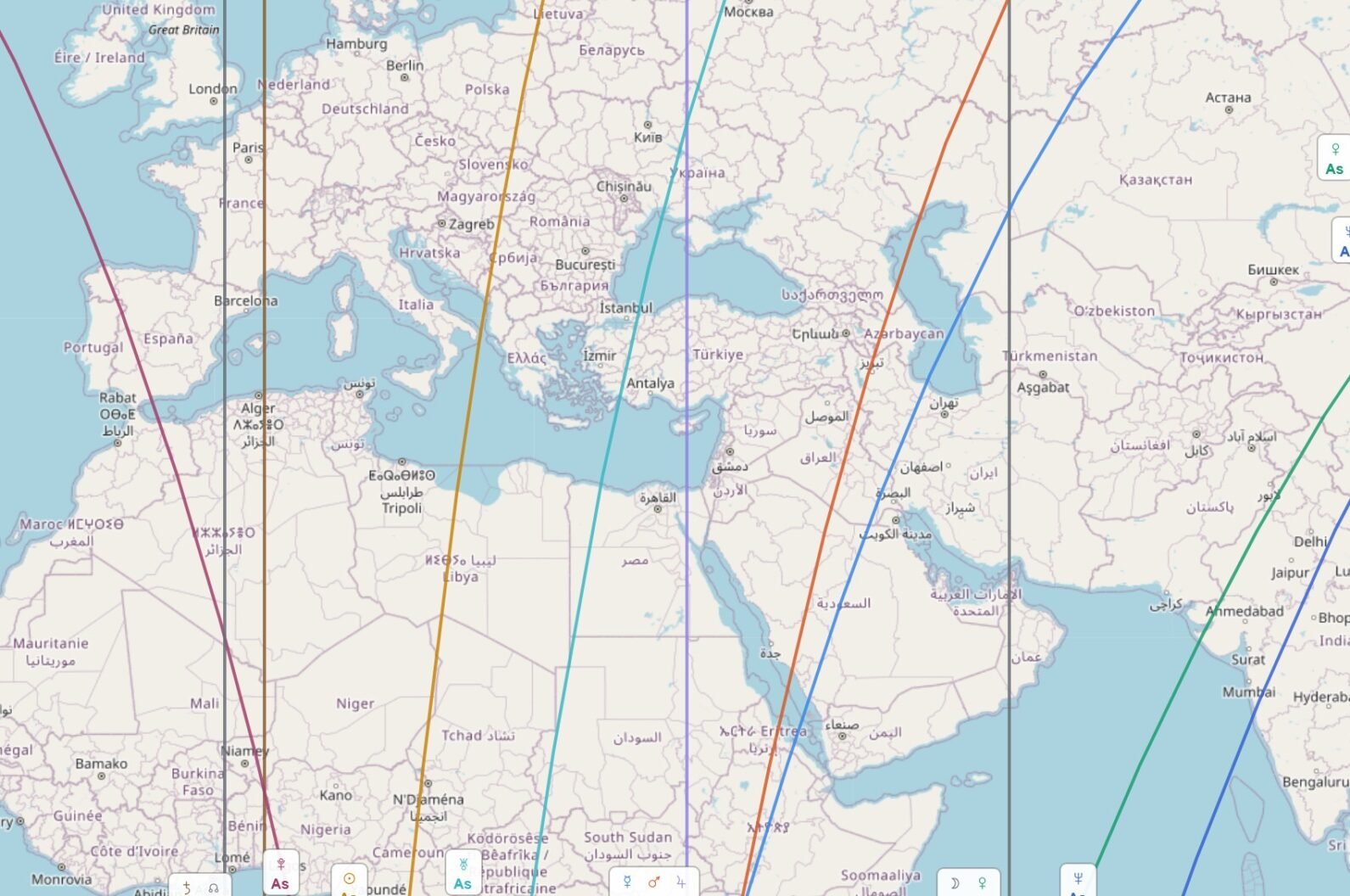
One page, three ways to see how place changes a chart: trace where a planet's influence runs strongest around the globe, recast the whole chart as if it had happened somewhere else, or follow each planet's compass direction out from the birthplace (or your home) in local space.
MC, IC, Asc, Desc — a conjunction line is also the opposition line to the angle on the far side.
90° to each angle — denser, off by default.
60° to each angle — off by default.
120° to each angle — off by default.
In mundo measures the aspect along the sky's daily rotation (hour angle) — the traditional Astro*Carto*Graphy convention, and this tool's default. In zodiaco measures along the zodiac belt (ecliptic longitude) instead, matching the Chart Relocation tool's own aspects. The two agree near the equator and can disagree by a full aspect at high latitude — see the footer note below.
Highlights where two different planets' conjunction/opposition (MC/IC/Asc/Desc) lines cross or run close together — the traditional paran, not computed for square/sextile/trine lines.
Each line leaves the centre point in the compass direction a planet lay in at the moment of birth and runs on around the globe. The fainter, thinner part is the same line continuing out the opposite way. Tick or untick planets in the list above.
…or click the exact spot on the map (zoom right in first).
A planet's line (color = planet)
☊ MC Where a line meets the map's edge, a small tag names the planet and line type (MC / IC / Asc / Desc)
Paran zone (crossing ± orb)
☉ Birthplace