Rasputin’s Birth Time: Rectifying the Ascendant from his Life and Death
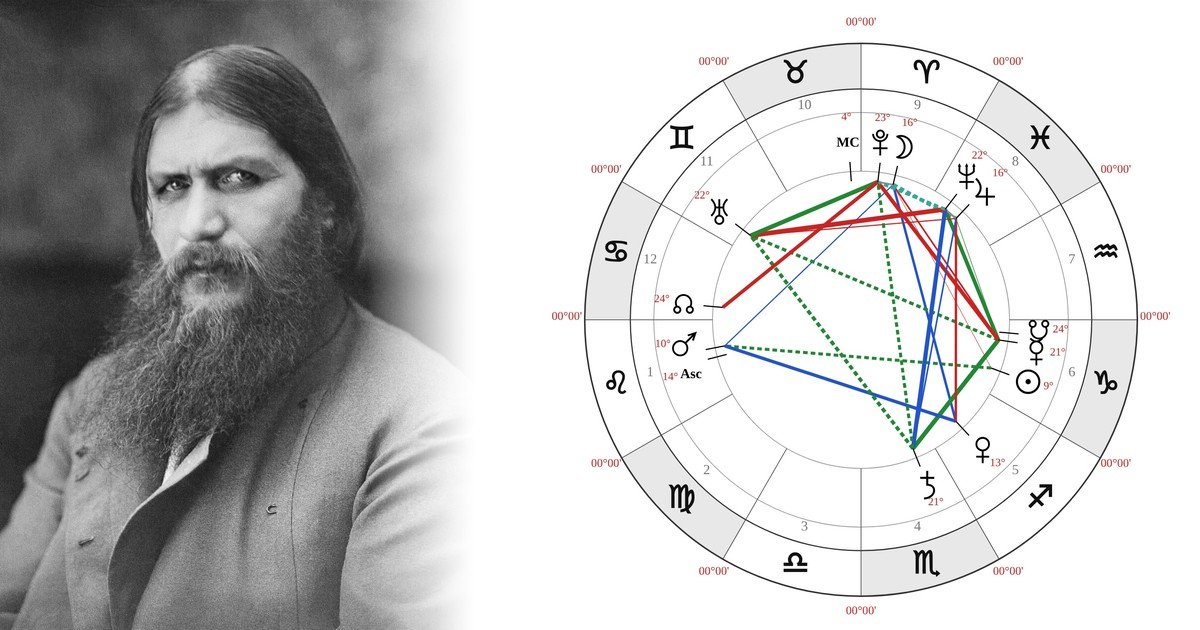
This is the second part of a study of Grigori Rasputin. The first part cast a chart for the moment of his murder and used converse progressions from that chart to time the turning points of his life. Here we turn to the other end of his life: his birth time, which no record preserves. Rectification is always speculative, and the aim is not to produce a certain answer but to see how far the well-documented events of an extraordinary life can narrow the birth time down, and what each technique contributes.
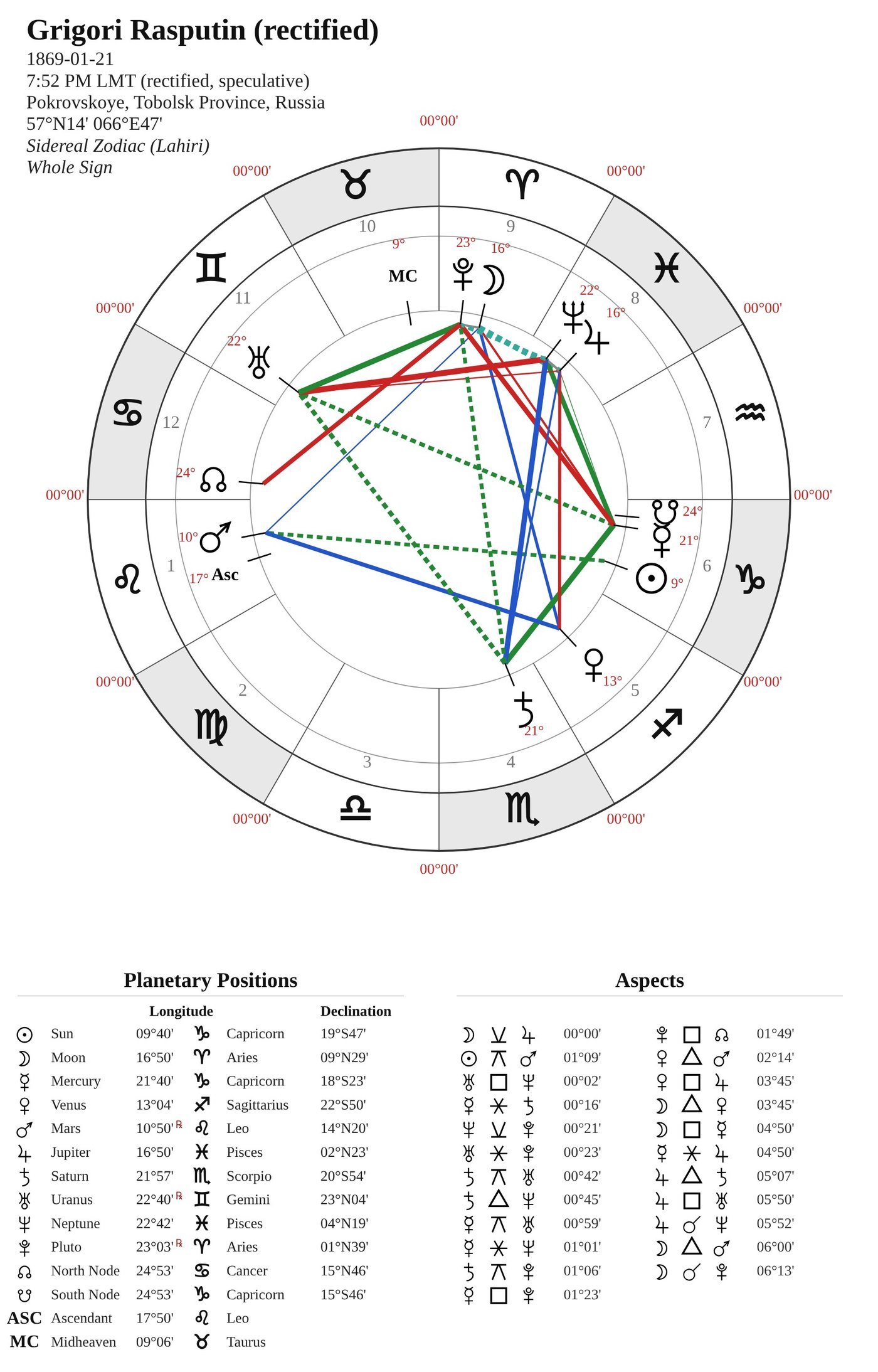
Rasputin was born in Pokrovskoye, in the Tobolsk Province of western Siberia, on 21 January 1869 (9 January Old Style). The date is reasonably well attested; the time is not. Working from the events of his life, the rising sign can be narrowed with some confidence to sidereal Leo (tropical Virgo), with natal Mars rising. Within Leo, two candidate times stand out, 7:52 pm and 7:31 pm local mean time, and on the evidence so far they are more or less equally convincing, with the transits at the two attempts on his life leaning slightly towards 7:31.
Key findings
- Rising sign: sidereal Leo (Lahiri), tropical Virgo. With whole-sign or Vehlow houses, Mars is in the 1st in both zodiacs.
- Candidate A, 7:52 pm: lagna 17°50′ Leo (tropical Ascendant 9°51′ Virgo). Supported by primary directions, solar arcs, the Life Time Scale and transiting Mars on the Ascendant at the knife attack.
- Candidate B, 7:31 pm: lagna 14°26′ Leo (tropical Ascendant 6°27′ Virgo). Supported by eclipses exactly on the Ascendant, slow transits to the angles, the transiting nodes on the horizon at the knife attack and transiting Mars sesquiquadrate the Ascendant at the death.
- Dashas: support Leo rising, but do not separate the two times.
The events
The rectification was tested against events whose dates are reasonably secure and whose character is clear. The times of the meetings with the imperial family come from Nicholas II’s diary; the time of death is the estimate arrived at in the first part of this study.
| Event | Date | Character |
|---|---|---|
| Marriage to Praskovya Dubrovina | 14 Feb 1887 | Partnership (7th house) |
| Religious conversion; pilgrimage to Verkhoturye | c. July 1892 | Spiritual turn (9th house) |
| Birth of his son Dmitri | 1895 | Children (5th house) |
| Arrival in St Petersburg | 1904 | Public life begins |
| First meeting with Nicholas and Alexandra | 14 Nov 1905 | Royal patronage (10th house) |
| Meeting the imperial children | 26 Oct 1906 | Patronage, healing |
| Pilgrimage to the Holy Land | spring 1911 | Pilgrimage (9th house) |
| Spała: Alexei’s crisis and the telegram | c. 13 Oct 1912 | Healing, reputation |
| Stabbed by Khioniya Guseva | 12 Jul 1914, about 3 pm | Violence, wounds (1st, 6th, 8th) |
| Murder at the Yusupov Palace | 30 Dec 1916, about 3:00 am, Petrograd | Death (8th house) |
Narrowing the rising sign
What the whole day shares
On 21 January 1869 every planet stays in the same sidereal sign from midnight to midnight. The only fast mover is the Moon, which travels from about 6½° to 19° of sidereal Aries during the day, crossing from the nakshatra Ashwini into Bharani at about 1:10 pm. So whatever the birth time, Aries is the chandra lagna, the Moon taken as an Ascendant from which the houses are projected, and the 10th from the Moon is Capricorn.
Because the signs are fixed, the birth time changes only which sign rises and therefore which houses the planets occupy. That makes it possible to read the twelve possible lagnas side by side and ask which best describes the man: a rough and physically forceful presence, a sudden religious conversion, patronage from the very top, scandal, and a violent death.
Scanning the twelve lagnas
All twelve possible lagnas were scanned with a reference text that interprets each planet in its sign in relation to each Ascendant. The aim was not to match single phrases but to find the overall pattern that fits the life: a rough and physically forceful man, a sudden religious conversion and years of pilgrimage, a reputation as a healer, patronage from the very top, scandal and religious controversy, and two attempts on his life, the first of which he survived against expectation. Four lagnas stood out. The salient passages that made each a viable candidate are quoted below.
Leo lagna (18:04–21:08)
- Mars in the 1st, as yogakaraka (lord of the 4th and 9th): “courageous, energetic, confident and ambitious… may be athletic or of a strong build. They may be impatient or quick-tempered.” Its aspect on the 7th “may bring some conflict or forcefulness in marriage”.
- Moon in the 9th, as lord of the 12th: “there may be some problem or issue with religion or spiritual teachings or teachers. The person enjoys travel to remote foreign countries… there is some susceptibility to controversy over religious or moral issues.”
- Jupiter in its own sign in the 8th (Sarala Yoga): “gives longevity and resilience in the face of crisis. The person may have a deep interest in the occult… or spiritual research.”
- Rahu in the 12th, Ketu in the 6th: the person “may be drawn to unusual spiritual practices”, while Ketu “defeats enemies and competitors, and may have a natural gift for healing”.
- Sun, the lagna lord, in the 6th: “There may be a clinical or critical streak, and the person may experience conflict with others”; “They may take a great interest in health and the health sciences.”
Libra lagna (00:16–03:24)
- Moon in the 7th, as lord of the 10th: “they will tend to be attracted to socially influential people… their public life is closely linked to partnerships.”
- Rahu in the 10th: “may achieve sudden success, fame or prominence in their career, perhaps through… unconventional fields.”
- Jupiter in its own sign in the 6th (Harsha Yoga): “the person overcomes enemies, competition and illness” and “may work in healthcare, healing…”.
- Mars in the 11th: “The person has influential, powerful and assertive friends.”
- Against it: the lagna lord Venus in the 3rd describes someone “lively, sociable and active” with an interest in “the arts”, which suits the man less well.
Aries lagna (10:28–11:16)
- Moon in the 1st: “attractive or possesses a charismatic personality; they stand out and enjoy attention.”
- Jupiter in its own sign in the 12th, as lord of the 9th (Vimala Yoga): “may be drawn to meditation, retreat, or life in an ashram or monastery”, with “long pilgrimages”.
- Ketu in the 10th: “an unusual career. The person may pursue spiritual work, or work behind the scenes.”
- Saturn in the 8th, as lord of the 10th: “disruptions and upheavals in their career”.
Pisces lagna (09:52–10:28)
- Jupiter in the 1st (Hamsa Yoga): “may succeed in teaching, counselling, law, religion, healing”.
- Saturn in the 9th: “unconventional or austere beliefs”, with “foreign travel, pilgrimage”.
- Mars in the 6th, as lord of the 9th: “able to defeat enemies and rivals”, with “some tendency to fevers, inflammation or minor injuries”.
- Against it: the Hamsa figure, “wise, generous, principled and respected, with a dignified appearance”, fits his reputation better than the rough Siberian peasant, so Pisces was kept only as an extra check.
Leo was favoured from the start because two independent placements describe the core of the story: Mars rising describes the man, and the Moon as 12th lord in the 9th describes the religious controversy and the wandering pilgrim. Sarala Yoga adds his notorious resilience. Beyond the text, natal Mars falls in Magha, the nakshatra of thrones and ancestors, linking that rising force, as 9th lord, to religion and the throne.
The dashas
The Vimshottari dashas fitted Leo best. With the Moon in Bharani, the life opens in the Venus mahadasha, followed by the Sun, the Moon, Mars and then Rahu:
- Marriage (1887): Sun/Saturn. Saturn is the 7th lord for Leo.
- Conversion (1892): Moon/Rahu. The Moon is in the 9th.
- Knife attack (1914): Rahu/Saturn. Saturn rules the 6th and 7th.
- Death (1916): Rahu/Mercury. Mercury rules the 2nd (and the 11th), so it is a maraka, a death-inflicting planet, for Leo lagna, and it sits in the 6th, the house of injury and enemies. Rahu, the mahadasha lord, is in the 12th, the house of loss and endings.
Aries came second; Libra and Pisces fell away. The late-morning Aries window (about 11:00–11:07 am) did produce some hits, including solar arc Jupiter to the Ascendant at the meeting with the royals and Mars directed to the IC at the death, but they were fewer and scattered, while the Leo times collected repeated hits from independent techniques.
Two candidates within Leo
Minute-by-minute sweeps of the Leo window with primary directions, progressions, solar arcs, the Life Time Scale, transits and eclipses produced two clusters of hits, one centred on 7:52 pm and one on 7:31 pm.
| Candidate A: 7:52 pm | Candidate B: 7:31 pm | |
|---|---|---|
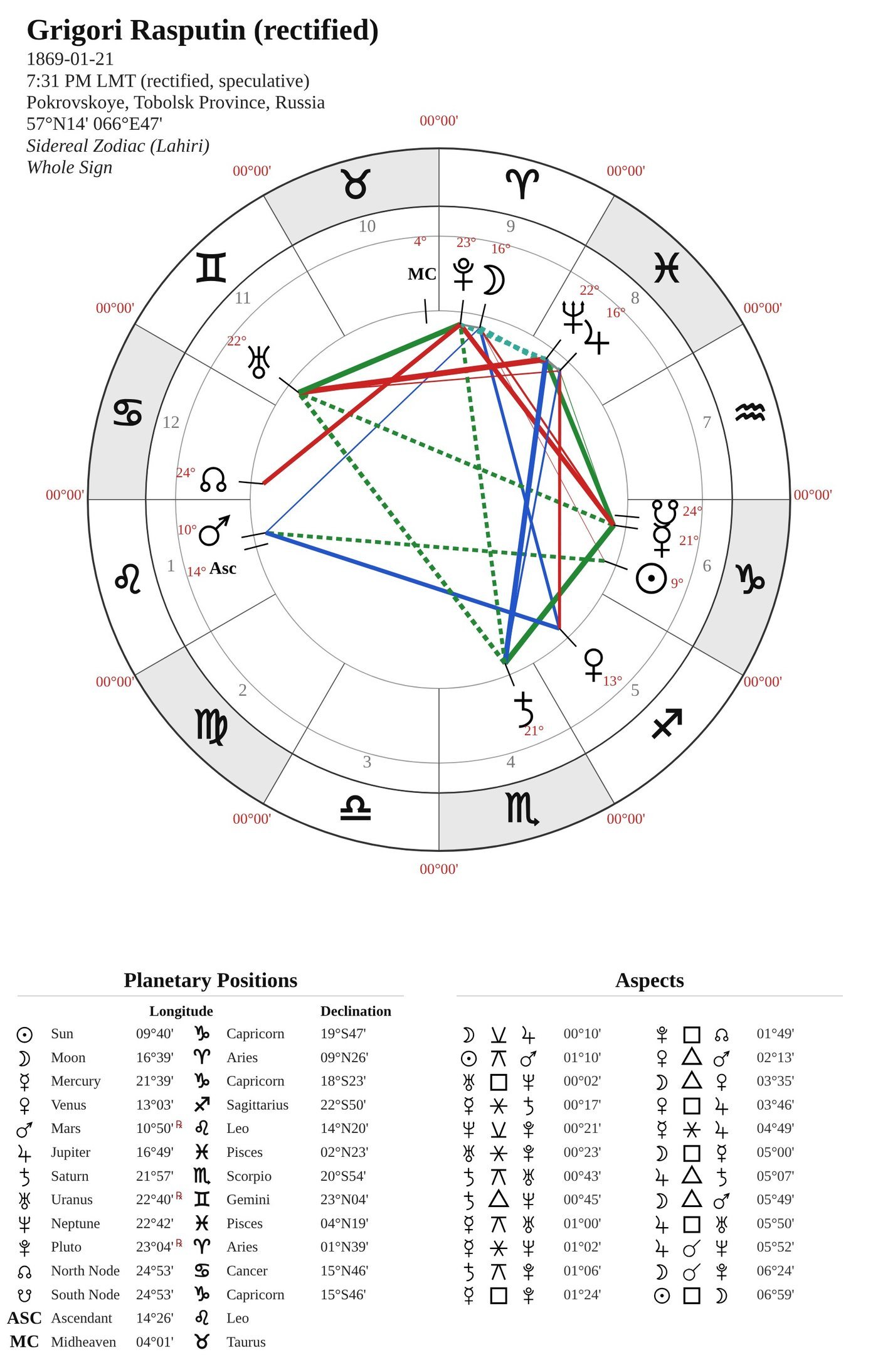
| Sidereal lagna (Lahiri) | 17°50′ Leo | 14°26′ Leo |
| Tropical Ascendant | 9°51′ Virgo | 6°27′ Virgo |
| Natal Mars (10°50′ Leo sidereal, 2°51′ Virgo tropical) | 1st house by whole sign and Vehlow; 12th in Placidus | 1st house by whole sign and Vehlow; 12th in Placidus |
| Moon (sidereal) | 16°50′ Aries | 16°39′ Aries |
The case for 7:52 pm
- Primary directions: Uranus to the MC at the death; Neptune to the MC at the knife attack; Venus, the 10th lord, to the IC at the meeting with the royals; Jupiter to the Descendant at Spała.
- Solar arcs: Neptune and Uranus to the MC at the knife attack; the solar arc Sun sextile the natal Moon within 4′ at the meeting with the royals (14′ at 7:31).
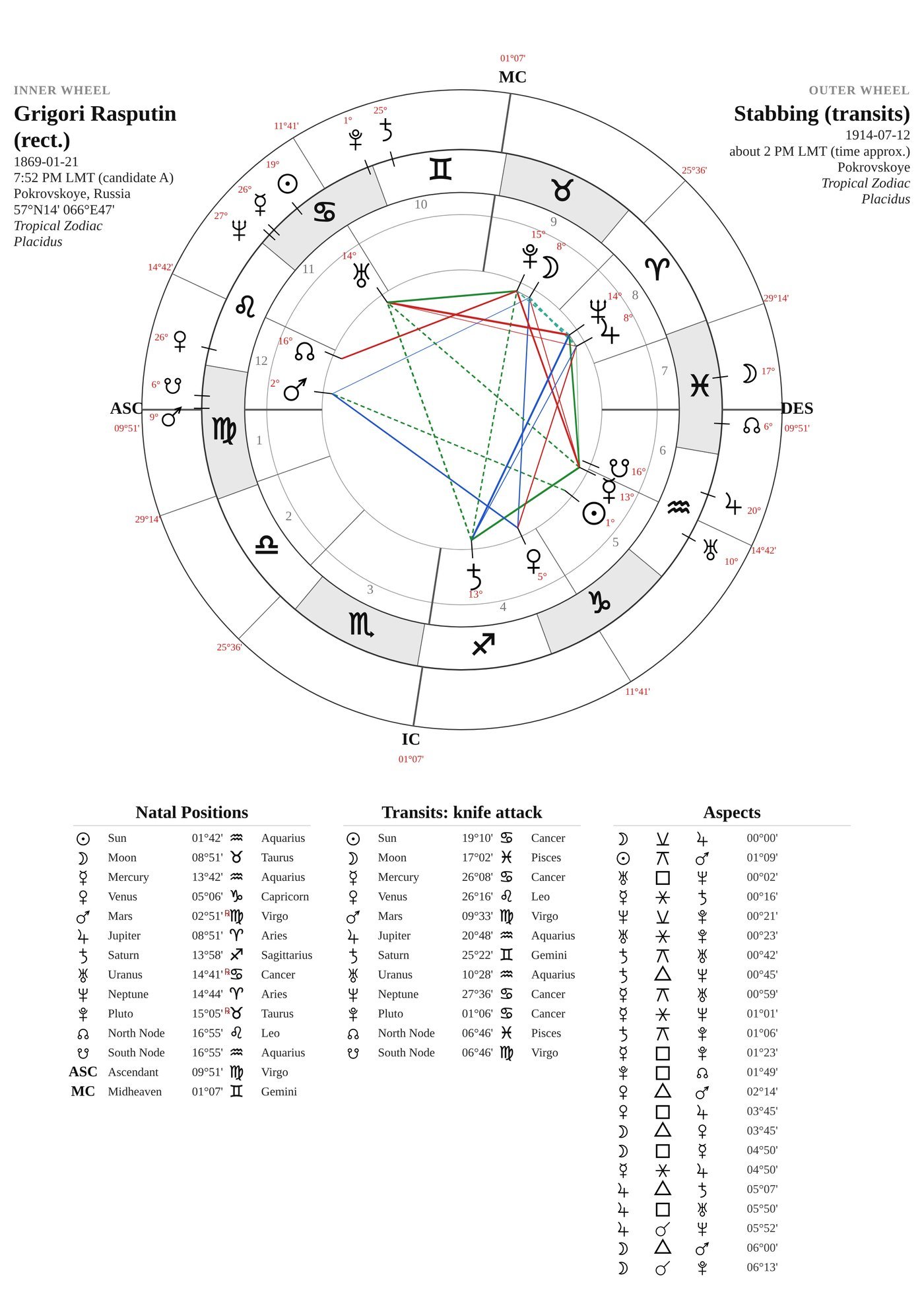
- Transits: Neptune square the Ascendant at the conversion, and transiting Mars on the Ascendant at the knife attack, within 17′.
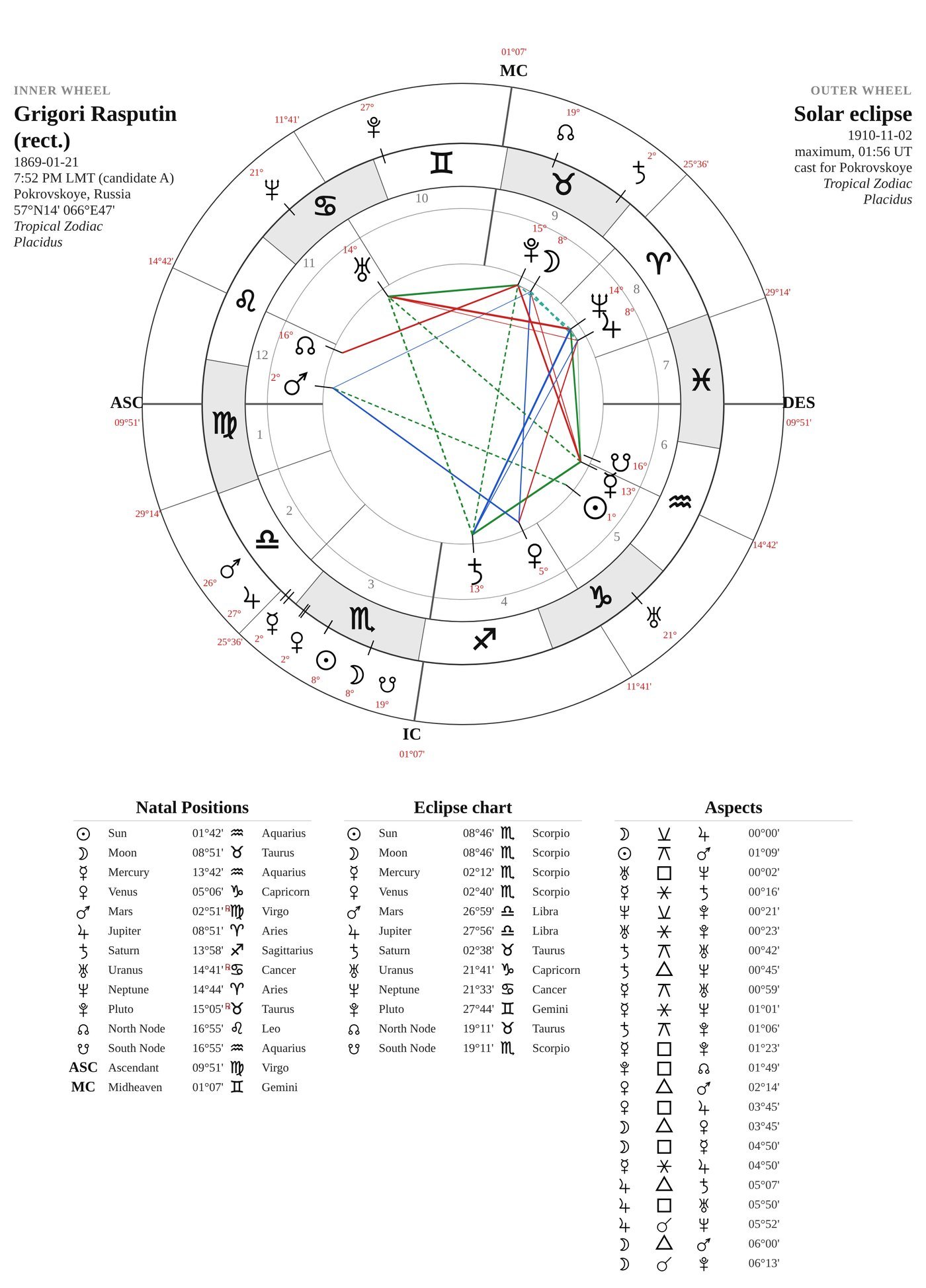
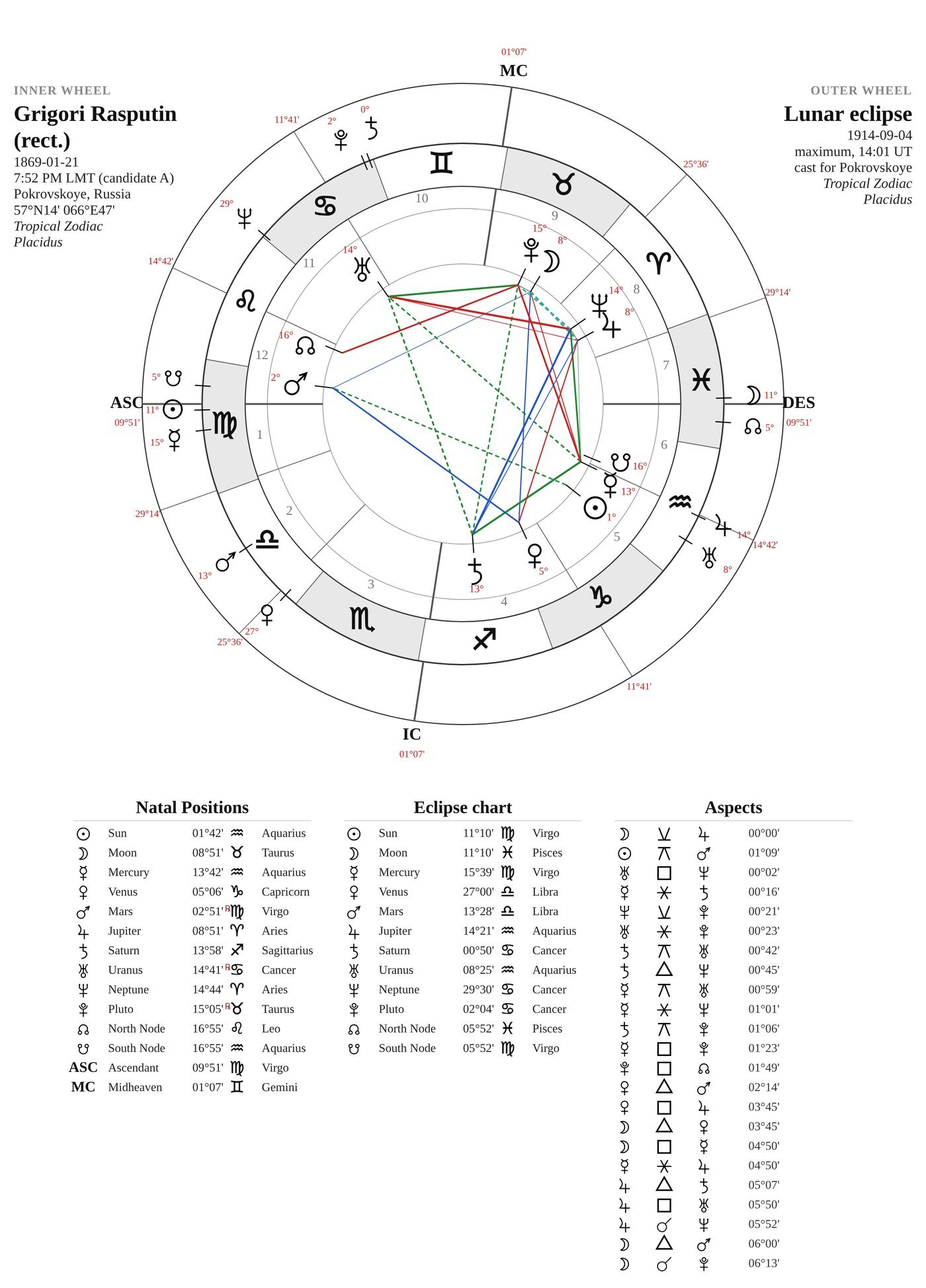
- Eclipses: the solar eclipse of 2 November 1910 fell exactly opposite the natal Moon (5′), before the Holy Land pilgrimage; the lunar eclipse of 4 September 1914, weeks after the stabbing, fell on the Descendant; eclipses fell on the Moon in the 9th in 1892 and 1911, the years of the conversion and the pilgrimage.
- The death chart: Venus, ruler of the death chart’s sidereal lagna, squared the 7:52 Ascendant within 17′.
The case for 7:31 pm
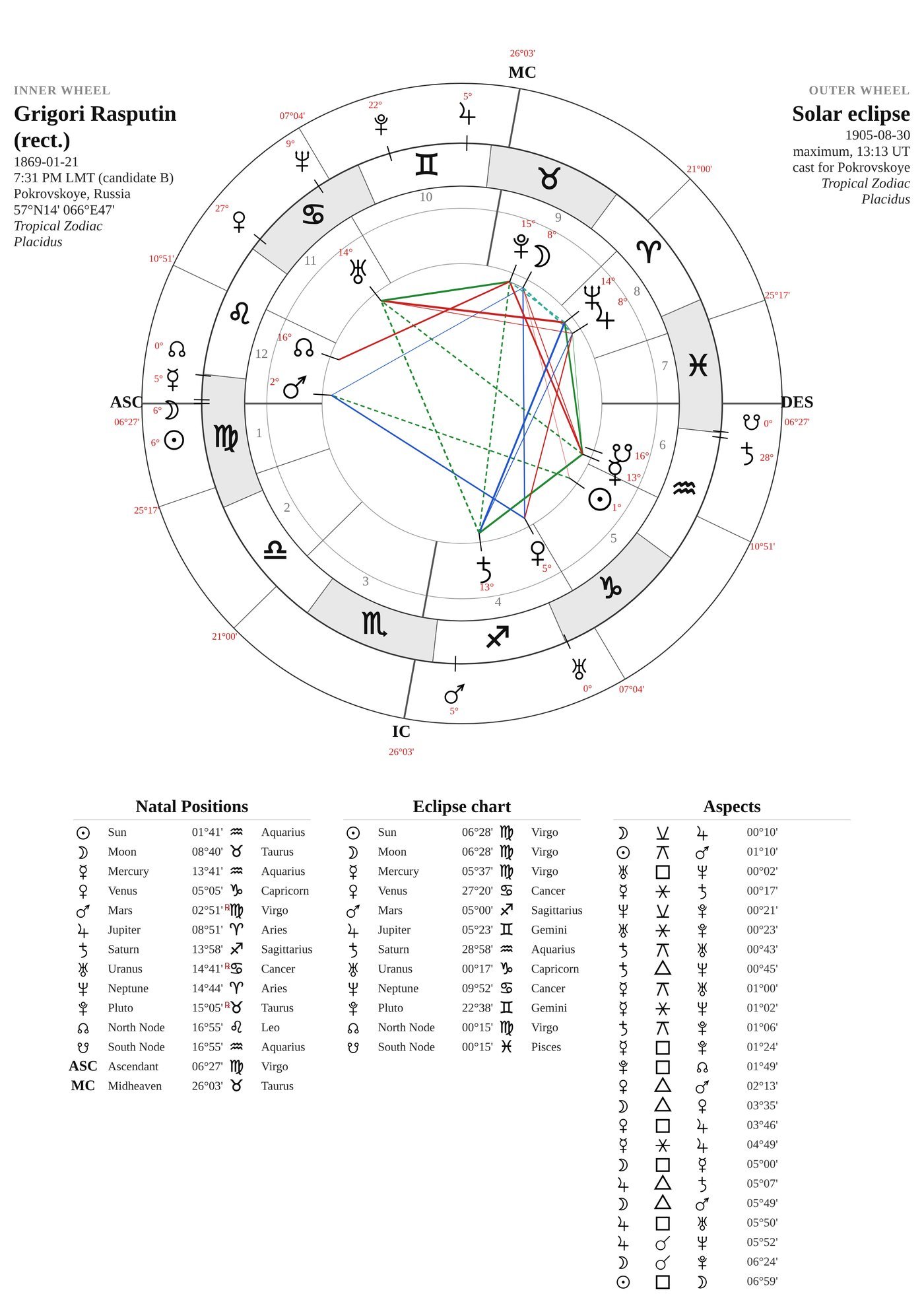
- Eclipses on the Ascendant: the solar eclipses of August 1886 (24′), shortly before the marriage, and 30 August 1905 (0′), the year he met the imperial family, both fell on the 7:31 Ascendant; the eclipse of February 1914 fell opposite it (54′), months before the knife attack.
- Slow transits to the angles: Neptune on the MC in 1886–87 (marriage); Pluto and Neptune square the Ascendant in 1889–92 (conversion); Jupiter on the MC and square the Ascendant in 1905 (the royals); Saturn on the MC in June 1912, the time of scandal and his removal from St Petersburg.
- The knife attack: see below.
- The death: transiting Mars sesquiquadrate (135°) the Ascendant within 20′. The aspect had become exact about six hours before the shooting, on the evening he went to the Yusupov Palace.
The knife attack
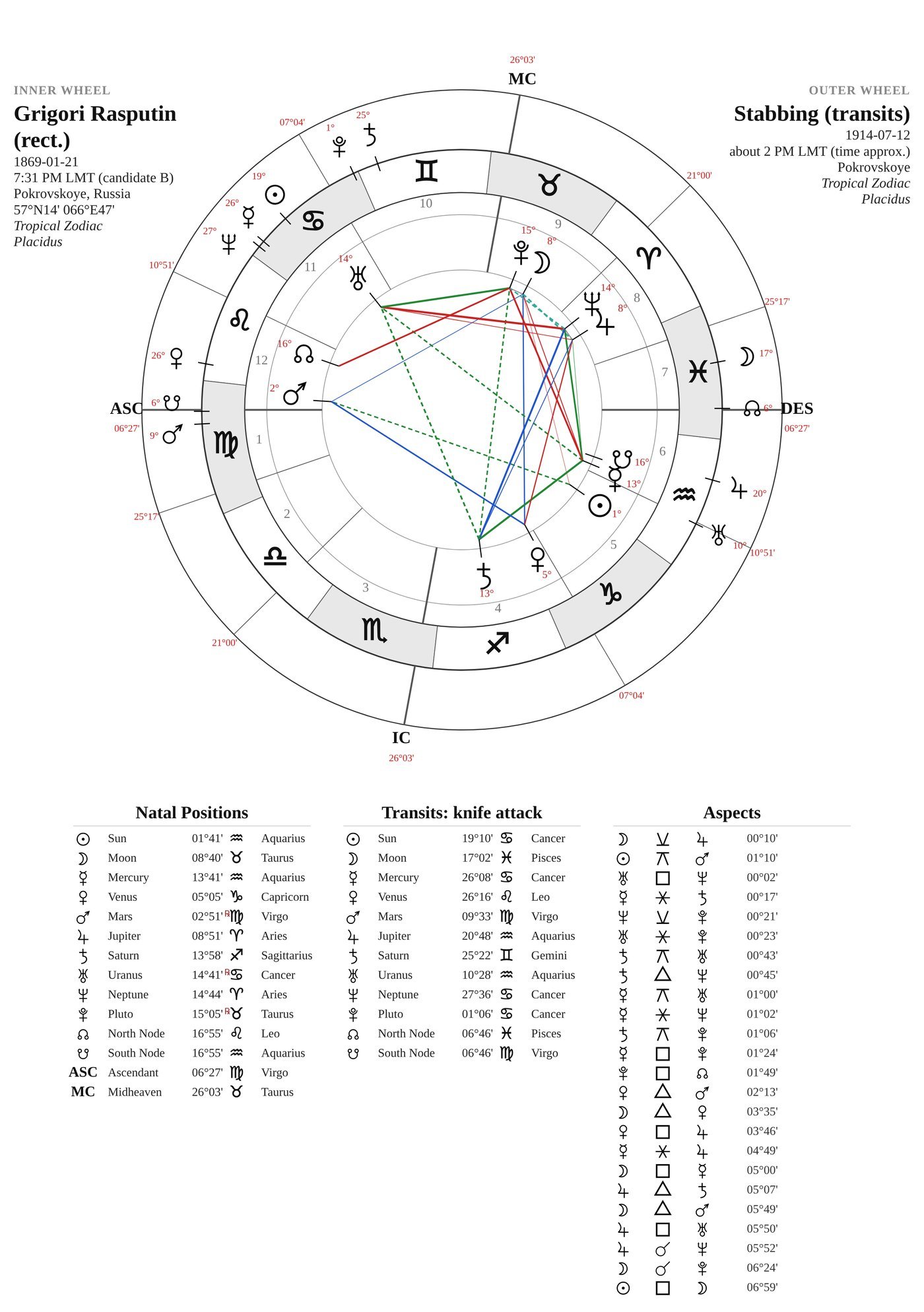
On 12 July 1914 Khioniya Guseva, a follower of Rasputin’s enemy the monk Iliodor, stabbed him in the abdomen outside his house in Pokrovskoye. He was not expected to survive. Both candidates respond to the attack, in different ways.
For 7:52, transiting Mars stood on the Ascendant within 17′. For 7:31, the transits form a tighter cluster: the transiting South Node (true node) at 6°47′ Virgo was 19′ from the Ascendant, with the North Node on the Descendant, and the Ascendant fell at the midpoint of natal Mars (2°51′ Virgo) and transiting Mars (9°34′ Virgo), within 14′. Transiting Mars stood as far past the Ascendant as natal Mars stands before it. The Ascendant, the South Node and the Mars midpoint fall within about 35′ of each other, on the degree where the 1886 and 1905 eclipses fell. With the mean node, the nodal contact widens to 1°45′.
In sidereal terms the same picture reads as transiting Ketu on the 7:31 lagna and Rahu transiting the 7th, the house of open enemies. Rahu was also the mahadasha lord, and Saturn, the antardasha lord, rules the 7th. Natal Ketu sits in the 6th, the house of wounds. At 7:31 the pratyantardasha (third level) is Rahu as well; at 7:52 it is Jupiter, which, in its own sign in the 8th, is better suited to his survival than to the wound.
Where the dashas differ
The Moon moves only about 11′ between 7:31 and 7:52, which shifts the dasha dates by about three months. So for eight of the ten events the two times share the same periods. They differ in 1904–06:
| Event | 7:52 pm | 7:31 pm |
|---|---|---|
| Arrival in St Petersburg, 1904 | Mars/Ketu | Mars/Mercury |
| Meeting the royals, 14 Nov 1905 | Mars/Sun, beginning that very day | Mars/Venus (10th lord) |
| Meeting the imperial children, 26 Oct 1906 | Rahu/Rahu, the Rahu mahadasha 5 days old | Mars/Moon |
7:31 places the first meeting with the Tsar in the sub-period of the 10th lord, the natural period for royal patronage. 7:52 instead has period changes within days of two turning points: the sub-period of the Sun, the lagna lord, begins on the day of the meeting, and the Rahu mahadasha begins five days before he met the imperial children. Such precision needs caution, as a minute of birth time moves these dates by about five days and an arc-minute of ayanamsha by about nine.
The Life Time Scale
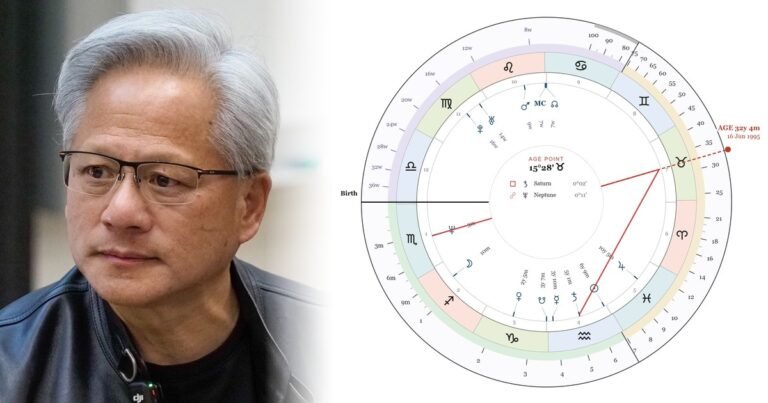
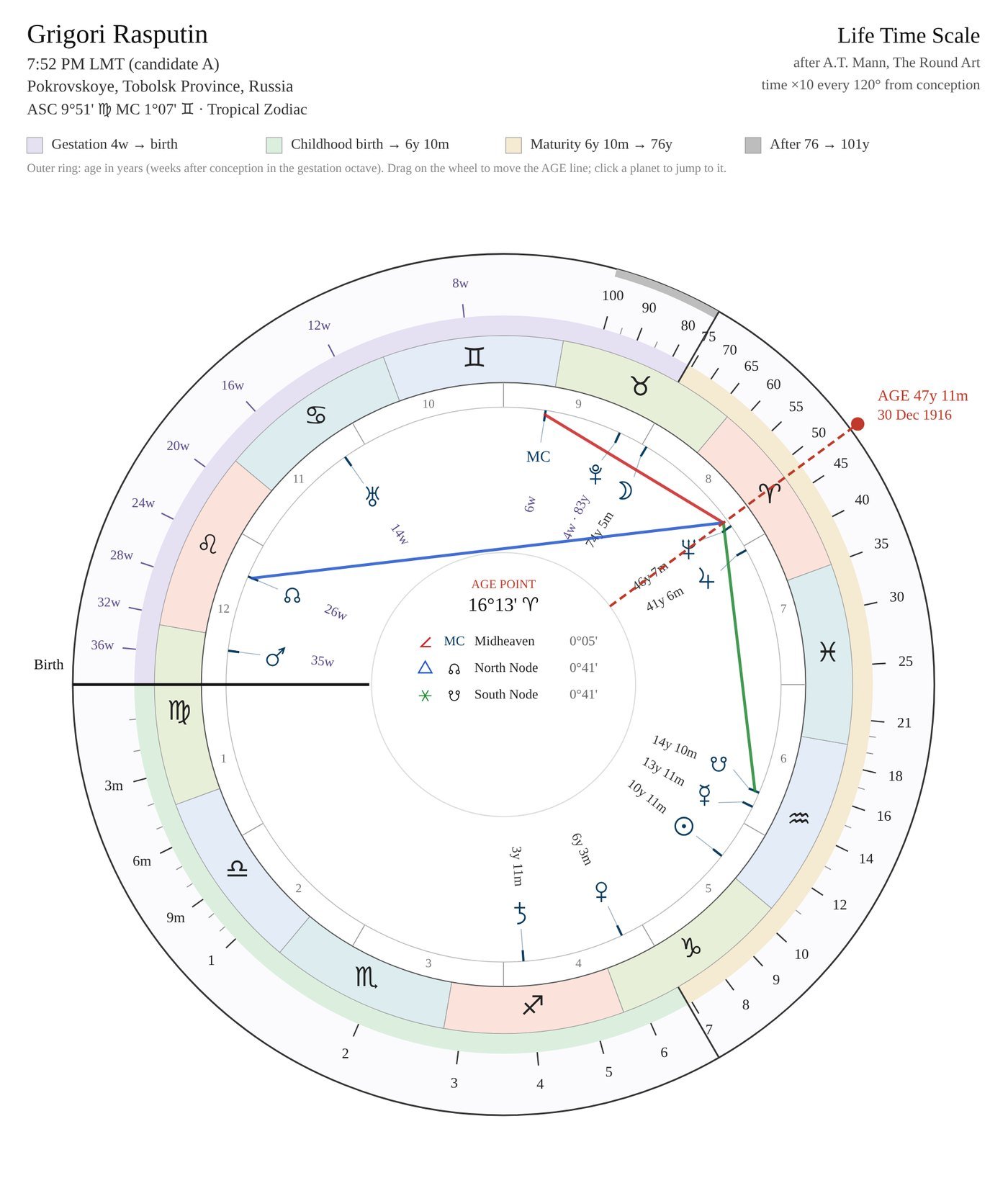
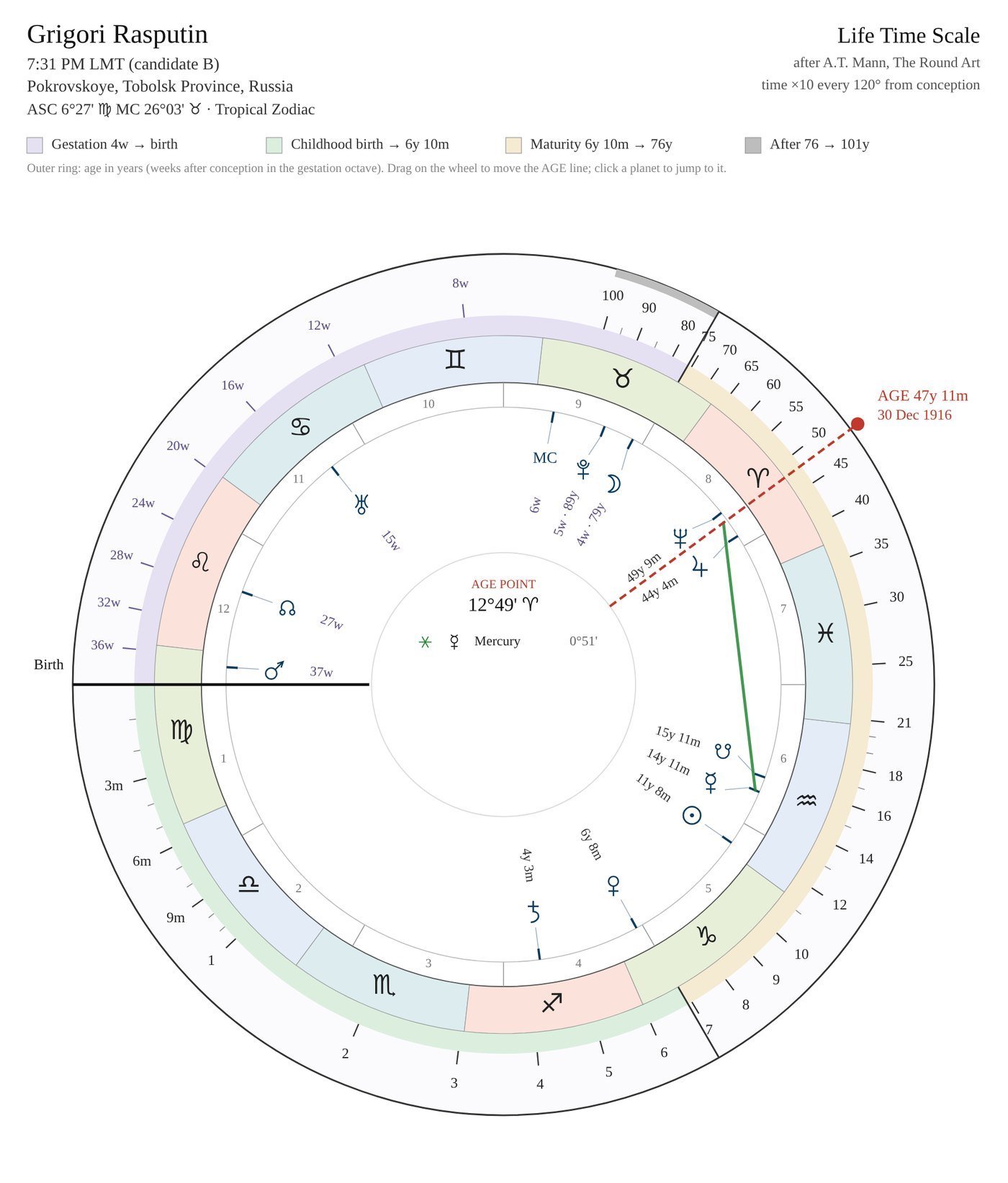
A.T. Mann’s Life Time Scale reads the chart as a logarithmic clock. The age point starts at conception and moves anticlockwise from the Ascendant, each 120° covering ten times as much time as the one before: gestation, then childhood to about 7, then maturity to about 76. A planet is activated when the age point reaches it or a major aspect to it. Because the scale is measured from the Ascendant, a few minutes of birth time move every age, which makes it a useful rectification tool.
| Event | 7:52 pm age point | Contacts | 7:31 pm age point | Contacts |
|---|---|---|---|---|
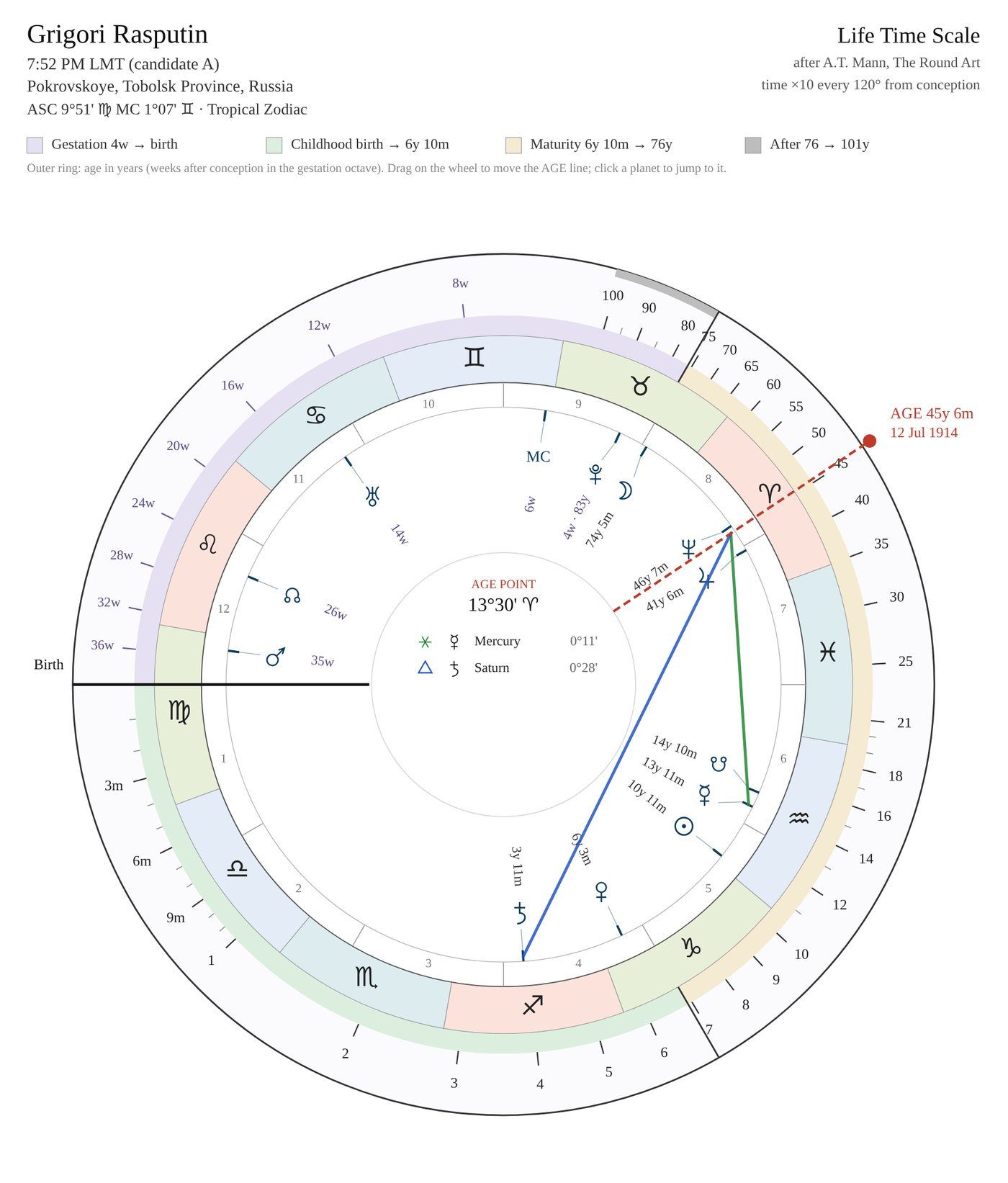
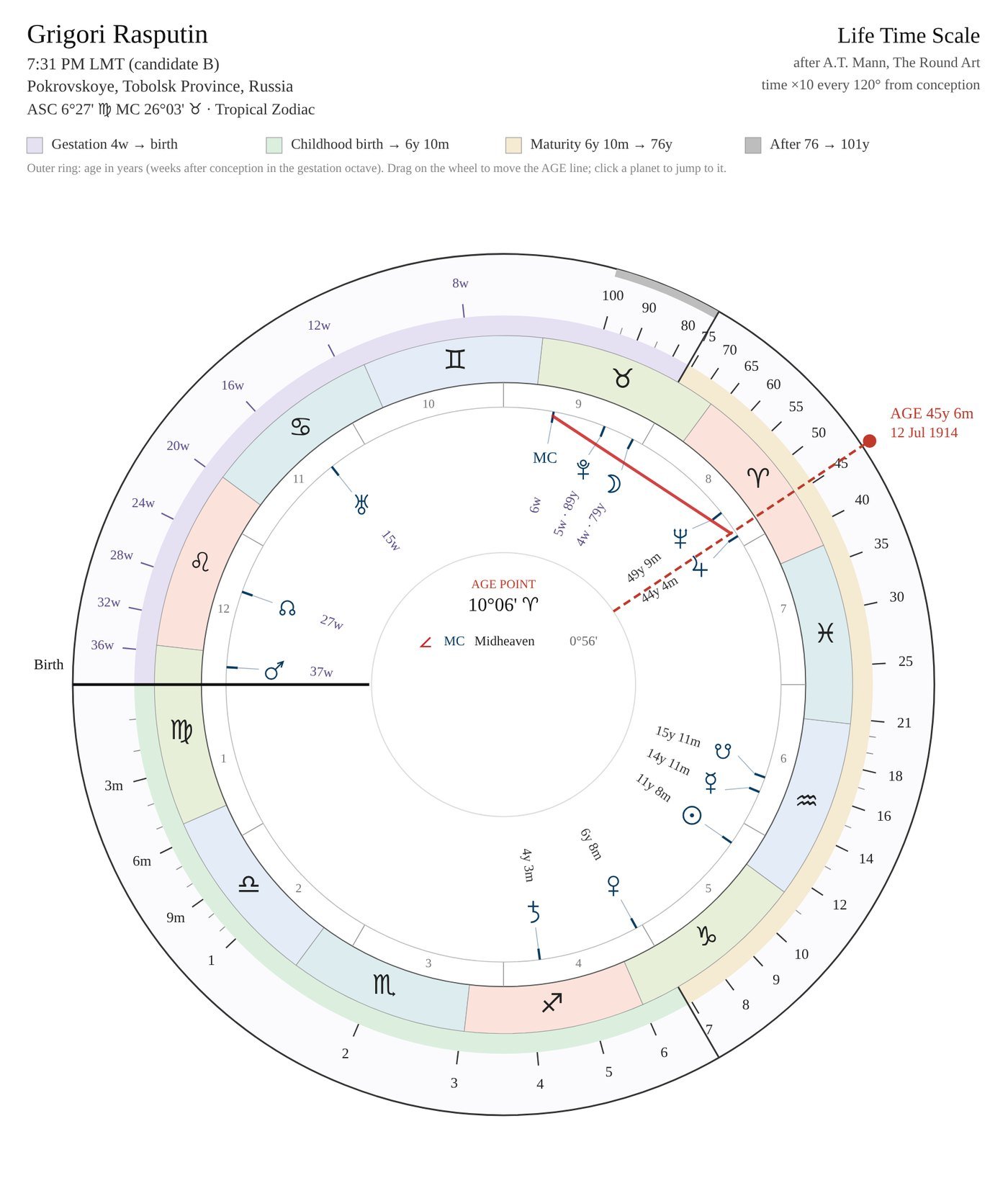
| Knife attack, 1914 | 13°31′ Aries | trine Saturn 28′, sextile Mercury 12′ | 10°07′ Aries | conjunct Jupiter 1°15′ |
| Death, 1916 | 16°13′ Aries | trine North Node 41′ | 12°49′ Aries | sextile Mercury 52′, trine Saturn 1°10′ |
Each candidate ties the Mercury–Saturn combination to one of the two violent events: at 7:52 the age point trines Saturn, ruler of the 6th and 7th, at the knife attack; at 7:31 it reaches the same pair at the death.
Midpoints fill out the picture. Natal Uranus (14°41′ Cancer) opposes the Mercury/Saturn midpoint (13°51′ Capricorn) within 51′, so the three planets form a single natal configuration. At the knife attack, the 7:52 age point (13°31′ Aries) squares that midpoint within 20′ and Uranus within 1°11′, while also sextiling Mercury and trining Saturn. The age point therefore activates the whole Mercury–Saturn–Uranus complex at once: a fitting picture of a sudden, violent shock. At 7:31 the age point reaches the same complex at the death instead, but more loosely (the midpoint within 1°01′, Uranus within 1°53′).
The death chart and the birth chart
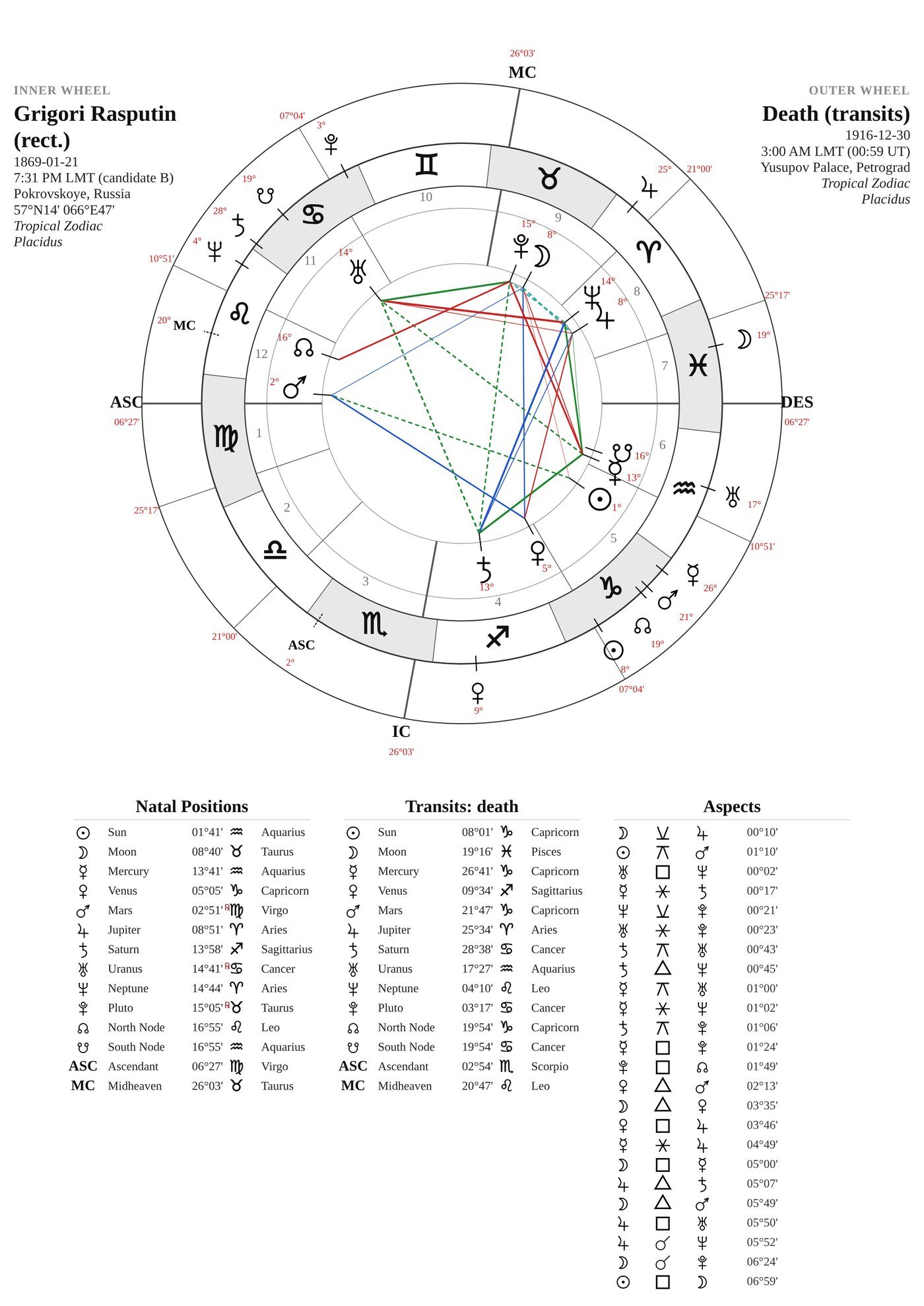
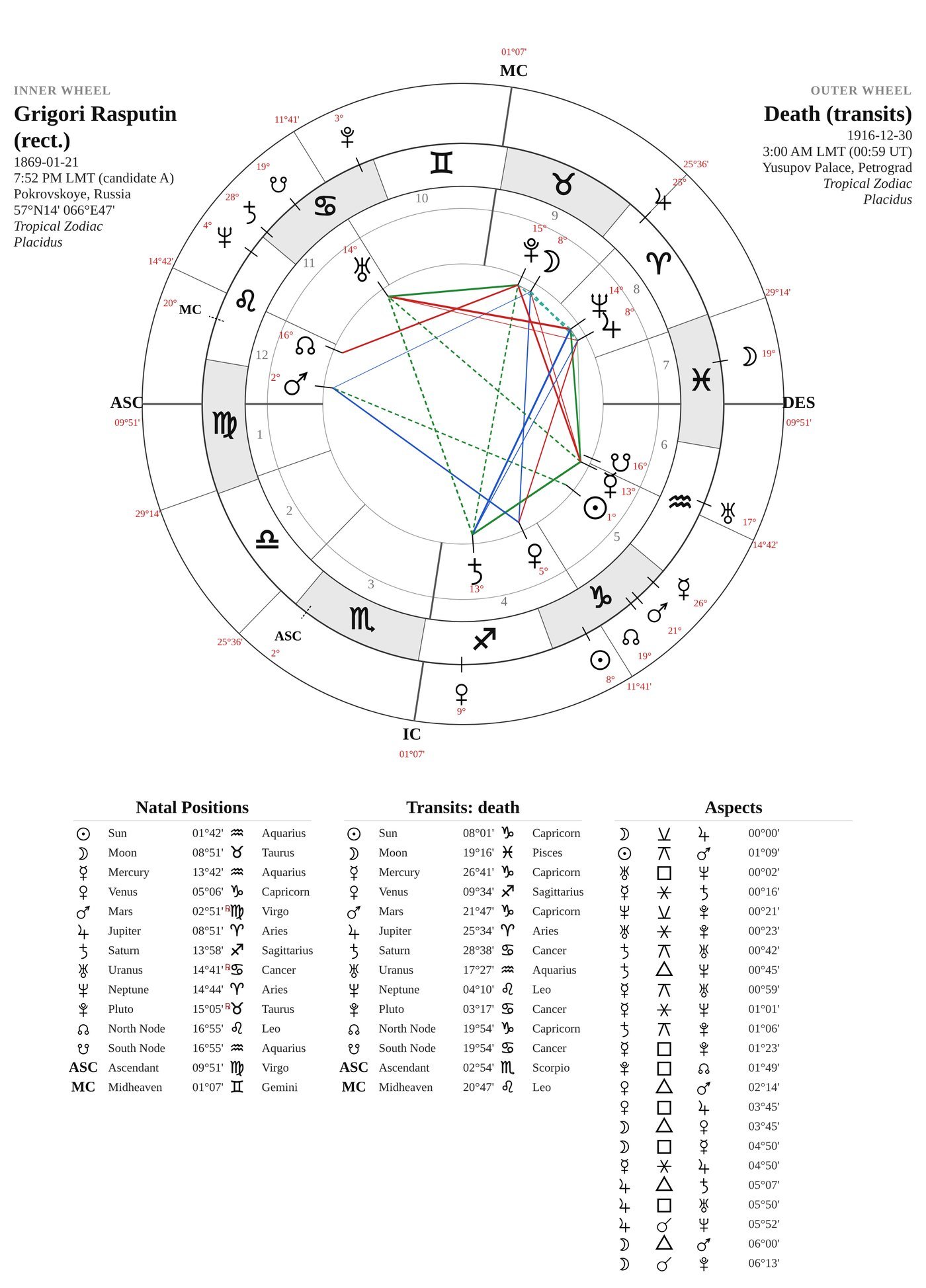
The death chart from the first part links to the natal chart in several ways:
- Death Ascendant and natal Mars. The death chart rises at 2°54′ Scorpio, sextile natal Mars (2°51′ Virgo) within 3′, and the midpoint of the death Ascendant and death Pluto (3°06′ Virgo) falls on natal Mars. Since natal Mars rises in both candidates, this supports Leo rising generally.
- Death Venus and the 7:52 Ascendant. Venus, ruler of the death chart’s sidereal lagna (Libra), squares the 7:52 Ascendant within 17′.
- Transiting Mars and the 7:31 Ascendant. Transiting Mars is 135° from the 7:31 Ascendant within 20′.
The chandra lagna, the Moon used as an Ascendant, adds a note that does not depend on the birth time. Eclipses fell in sidereal Capricorn, the 10th from the Moon, around the meeting with the royals, the meeting with the imperial children and the death (the solar eclipse of 23 January 1917, 24 days after the murder). Eclipses in the 10th from the Moon fit a life whose rise and fall were both bound up with the throne.
Tropical or sidereal transits?
The bi-wheels above are tropical. Measured sidereally, transits to a natal chart shift by the precession between the two dates, about 40′ for 1914–16. That makes a difference to some of the tight contacts, and it favours 7:31:
- 7:31: South Node on the lagna at the knife attack 19′ (unchanged); Mars 135° the lagna at the death 21′ (unchanged); 1905 eclipse on the lagna 30′.
- 7:52: transiting Mars on the lagna at the knife attack 55′ (17′ tropical); death Venus square the lagna 58′ (17′); 1910 eclipse opposite the Moon 40′ (5′).
Weighing the two
| 7:52 pm | 7:31 pm | |
|---|---|---|
| Primary directions | Strong: Uranus to MC at death, Neptune to MC at stabbing, Venus to IC at the royals, Jupiter to DSC at Spała | Weak |
| Solar arcs | Sun sextile Moon at the royals (4′); Neptune/Uranus to MC at stabbing | Sun sextile Moon looser (14′) |
| Dashas | Same periods for 8 of 10 events; Sun sub-period begins on the day of the royals meeting | Same periods for 8 of 10 events; Venus (10th lord) sub-period at the royals meeting |
| Eclipses | Opposite the Moon 1910 (5′); on the DSC Sept 1914 | On the Ascendant 1886 (24′) and 1905 (0′); opposite Feb 1914 (54′) |
| Slow transits to the angles | Neptune square Ascendant at the conversion | Neptune, Pluto, Jupiter and Saturn to the angles at the marriage, conversion, royals and 1912 scandal |
| Knife attack | Transiting Mars on Ascendant (17′); LTS trine Saturn | South Node on Ascendant (19′); Ascendant at the Mars midpoint (14′); Rahu dasha and transit |
| Death | Death Venus square Ascendant (17′) | Transiting Mars 135° Ascendant (20′); LTS sextile Mercury, trine Saturn |
Neither time wins on every count. The evidence for 7:52 is broader, drawing on several independent techniques whose hits cluster within a few minutes. The evidence for 7:31 is narrower but very precise, resting on eclipses within a degree of its Ascendant at turning points, the slow transits to its angles, and close, layered contacts to the Ascendant at both violent events. Those contacts also hold up better when the transits are measured sidereally.
The conclusion is sidereal Leo rising, at about 7:52 pm or about 7:31 pm local mean time. The two are more or less equally convincing, with the transits at the two attacks tilting slightly towards 7:31. Whichever is right, the study points firmly to Leo rising with Mars in the 1st house. A further firmly dated event, especially from the St Petersburg years, could separate the two times.
Method notes
- Positions computed with the Swiss Ephemeris. Sidereal positions use the Lahiri ayanamsha.
- Primary directions: Placidus semi-arc, Naibod key, zodiacal with latitude and mundane, direct and converse.
- Secondary progressions and solar arcs: a day for a year; angles by solar arc in longitude.
- Eclipses: all eclipses from 1885 to 1917 were checked from 190 days before to 100 days after each event, for whole-sign and Vehlow house placement and aspects to the angles and natal Moon.
- Bi-wheels and Life Time Scale wheels are tropical, Placidus; eclipse charts are cast for maximum eclipse.
- Several event dates are approximate (the conversion, the son’s birth, the move to St Petersburg), and the two Ascendants are only 3½° apart, so many contacts support both.
Sources
- Rasputin’s Death Chart: Timing Back from the Moment of Death, Sidereus Academy
- Grigori Rasputin, Khioniya Guseva and Pokrovskoye, Wikipedia
- Глава 5. Обретение Друга (Nicholas II’s diary entries), proza.ru
- Rasputin, the Romanovs, the Imperial Duma and the government, Taco Tichelaar
- A.T. Mann, The Round Art: The Astrology of Time and Space (1979), for the Life Time Scale
- Charts drawn with the Sidereus Astrology Suite.